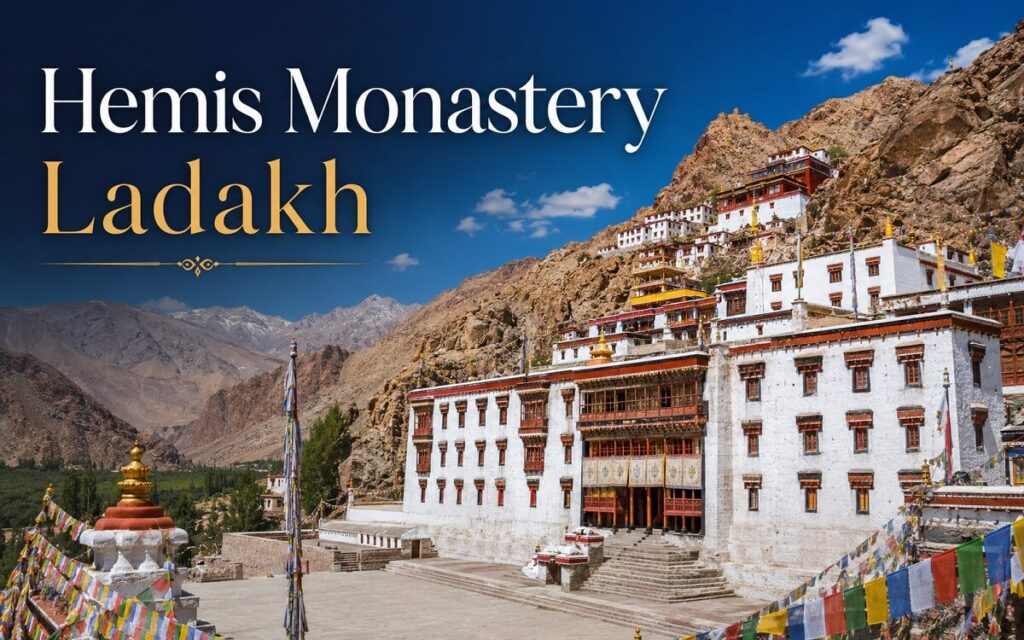
Hidden within a quiet mountain valley southeast of Leh, Hemis Monastery is one of Ladakh’s most important Buddhist landmarks. Unlike several monasteries that dominate hilltops and can be seen from miles away, Hemis Gompa remains concealed behind rugged mountains until visitors enter the narrow valley leading to it. This secluded setting gives the monastery a peaceful atmosphere that feels far removed from the busy roads and tourist areas around Leh.
Hemis Monastery is often introduced as the richest and oldest monastery in Ladakh. While it is widely regarded as one of the wealthiest, largest and most influential monasteries in the region, it is not technically Ladakh’s oldest monastery. Its present complex dates mainly to the 17th century, whereas some Ladakhi monasteries have much earlier foundations. Nevertheless, Hemis possesses centuries of religious history, rare Buddhist artworks, sacred objects, ancient manuscripts and an extraordinary cultural legacy.
The monastery belongs to the Drukpa lineage of Tibetan Buddhism and remains an active centre of worship, education and monastic life. It is also famous for the spectacular Hemis Festival, when monks perform sacred masked dances in the monastery courtyard to honour Guru Padmasambhava.
Located approximately 40 to 45 kilometres southeast of Leh, Hemis can be visited on a comfortable day trip. Travellers often combine it with Thiksey Monastery, Shey Palace, Stakna Monastery and other attractions in the Indus Valley.
This complete Hemis Monastery Ladakh guide covers its history, architecture, religious importance, museum, festival, timings, entry fees, transportation options, nearby places and practical travel advice.
Quick Facts About Hemis Monastery:
| Information | Details |
| Location | Hemis village, southeast of Leh, Ladakh |
| Distance from Leh | Approximately 40–45 kilometres |
| Altitude | Around 3,500 metres above sea level |
| Religious tradition | Drukpa lineage of Tibetan Buddhism |
| Present monastery established | 17th century |
| Associated ruler | King Sengge Namgyal |
| Founder and spiritual master | Stagtsang Raspa |
| Famous for | Hemis Festival, Buddhist art, museum and sacred treasures |
| Recommended visit duration | 1.5 to 2.5 hours |
| Best time to visit | May to October |
| Ideal starting point | Leh |
| Photography | Usually permitted outdoors; restrictions may apply inside temples and museum areas |
Hemis is regarded as one of the largest and wealthiest Buddhist monasteries in Ladakh. Historical accounts generally connect the present monastery with the period of King Sengge Namgyal and the Drukpa master Stagtsang Raspa during the 17th century.
Where Is Hemis Monastery Located?
Hemis Monastery is situated near Hemis village in the Indus Valley, approximately 40 to 45 kilometres southeast of Leh. The route initially follows the Leh–Manali road towards Karu. From Karu, travellers cross the Indus River and continue through a narrower mountain valley towards the monastery.
The final section of the journey is especially beautiful. Dry brown mountains rise on both sides of the road, while small cultivated fields, streams and clusters of trees add colour to the otherwise stark landscape.
One of the most interesting features of Hemis Monastery is its concealed position. Many Ladakhi monasteries are constructed on exposed ridges, but Hemis sits within a sheltered valley at the foothills of the mountains. The complex becomes clearly visible only when visitors approach the settlement.
This hidden location may have helped protect the monastery and its valuable collection during periods of political uncertainty and conflict.
History of Hemis Monastery
The history of Hemis Monastery is closely connected with the rise of the Namgyal dynasty and the expansion of the Drukpa Buddhist tradition in Ladakh.
The monastery in its present form was established during the 17th century under the patronage of King Sengge Namgyal, one of Ladakh’s most influential rulers. The king supported the Buddhist teacher Stagtsang Raspa, who played an important role in spreading the Drukpa lineage across Ladakh.
Some sources state that the monastery was established or enlarged during the 1630s, while others give 1672 as the date on which it was re-established. These variations may refer to different construction phases, restorations or the formal establishment of the present religious complex.
Under royal patronage, Hemis became a major spiritual institution. Land, religious objects, artworks and other resources were donated to the monastery, helping it grow into one of the wealthiest monastic centres in the Himalayan region.
Hemis also developed authority over several branch monasteries. Its influence extended beyond the immediate settlement, making it an important centre for monastic education, ritual practice and the preservation of Buddhist culture.
Despite its historical significance, Hemis should not be described as Ladakh’s oldest monastery in a literal sense. Older foundations exist at places such as Lamayuru and Alchi. A more accurate description is that Hemis is one of Ladakh’s most historic, powerful, prosperous and culturally important monasteries.
Why Is Hemis Called the Richest Monastery in Ladakh?
Hemis Monastery is frequently described as the richest monastery in Ladakh because of its extensive collection of religious art, sacred objects and historic treasures.
Its wealth is not limited to money. In the Buddhist monastic context, wealth also refers to cultural, spiritual and artistic heritage.
The monastery has preserved:
- Ancient Buddhist manuscripts
- Painted thangkas
- Ceremonial masks
- Sculptures and statues
- Ritual instruments
- Precious-metal objects
- Traditional weapons
- Historic jewellery
- Religious relics
- Objects associated with monastic ceremonies
For centuries, Hemis received support from Ladakhi rulers, noble families, devotees and communities associated with the Drukpa lineage. Its sheltered location may also have protected its collection from destruction and theft.
Many of the most valuable objects are now displayed or safeguarded inside the Hemis Museum. Visitors should not expect a glittering treasury filled with visible gold. The monastery’s true richness lies in the historic importance, craftsmanship and spiritual meaning of its collection.
Religious Importance of Hemis Gompa
Hemis Monastery is one of the principal centres of the Drukpa lineage, a school within Tibetan Buddhism. The lineage places strong emphasis on meditation, spiritual training, ritual practice and the transmission of Buddhist teachings from master to disciple.
The monastery remains an active religious institution rather than merely a historic tourist attraction. Monks live, study, pray and perform rituals here throughout the year.
Hemis is especially associated with Guru Padmasambhava, also called Guru Rinpoche. The eighth-century Buddhist master is traditionally credited with helping establish Vajrayana Buddhism in Tibet and is deeply revered across the Himalayan region.
The annual Hemis Festival celebrates Guru Padmasambhava’s birth anniversary. During the festival, ritual performances communicate Buddhist teachings through movement, costume, masks, music and symbolism.
Even outside the festival period, the monastery retains a deeply spiritual atmosphere. Visitors may hear low chanting from prayer halls, the sound of drums and horns, or the quiet movement of monks crossing the courtyard.
Popular Ladakh Holiday Packages:
- Leh Ladakh Sightseeing Tour for 6 Days
- Manali to Leh Ladakh Road Trip via Jispa for 8 Days
- Manali to Leh Ladakh Road Trip Package for 10 Days
- Leh Ladakh Tour Package for 5 Days
- Kashmir and Leh Ladakh Tour for 10 Days
- Leh, Kargil, Nubra Valley and Pangong Lake Tour for 9 Days
- Leh Ladakh Holiday Itinerary for 7 Days
- Kashmir Ladakh Itinerary with Leh and Kargil for 10 Days
Architecture of Hemis Monastery:
Hemis Monastery reflects traditional Ladakhi and Tibetan Buddhist architectural styles. Its whitewashed buildings, dark wooden windows, colourful painted details and enclosed courtyards create a striking contrast against the surrounding brown mountains.
The monastery does not appear as one perfectly symmetrical building. Instead, it consists of interconnected halls, residential quarters, courtyards, stairways, galleries, storerooms and shrines constructed at different levels.
The Central Courtyard
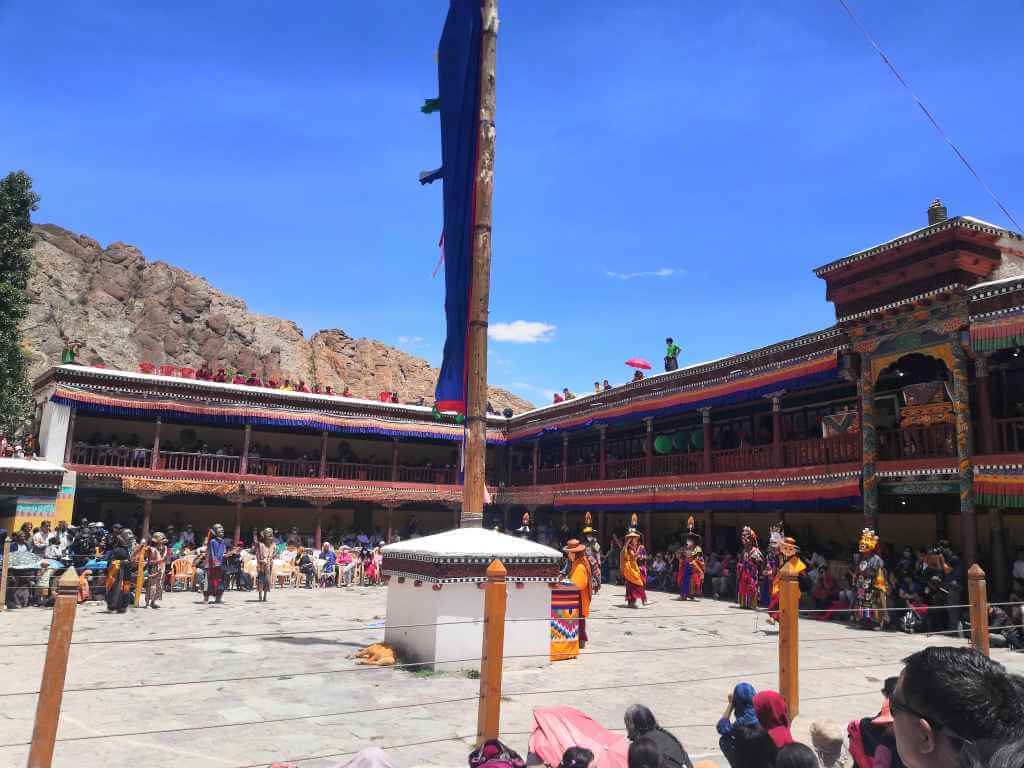
The large stone-paved courtyard is the visual and ceremonial centre of Hemis Monastery. It is surrounded by multi-level buildings with wooden balconies and painted windows.
During ordinary days, the courtyard feels calm and spacious. During the Hemis Festival, it becomes the main performance arena for sacred masked dances. Monks, pilgrims, local families, photographers and travellers gather around the courtyard to watch the ceremonies.
A tall ceremonial pole stands near the centre, adding to the courtyard’s traditional character.
Prayer Halls
The monastery contains several religious halls decorated with Buddhist statues, murals, thangkas and ritual objects. The interiors are generally dimly lit, creating an atmosphere that feels intimate and contemplative.
Butter lamps, painted pillars, fabric hangings and incense contribute to the spiritual environment. Some halls contain images of Guru Padmasambhava, the Buddha and protective deities associated with Tibetan Buddhism.
Visitors should enter quietly and follow any instructions provided by monks or attendants.
Murals and Paintings
Hemis is known for murals created with traditional pigments, including works decorated with gold and natural materials. These images are not simply decorative. They communicate Buddhist teachings, spiritual lineages and symbolic representations of enlightened beings.
The paintings may depict Buddhas, bodhisattvas, gurus, mandalas and guardian deities. Their meaning can be difficult to understand without guidance, so hiring a knowledgeable local guide can make the visit more rewarding.
Residential Areas
Parts of the complex are used as living quarters, kitchens, offices, classrooms and storage areas for the monastic community. These sections may not be accessible to tourists.
Respect barriers and private areas, even when doors appear open. Hemis is a functioning monastery, and the privacy of monks and students should always come before photography or sightseeing.
Hemis Museum
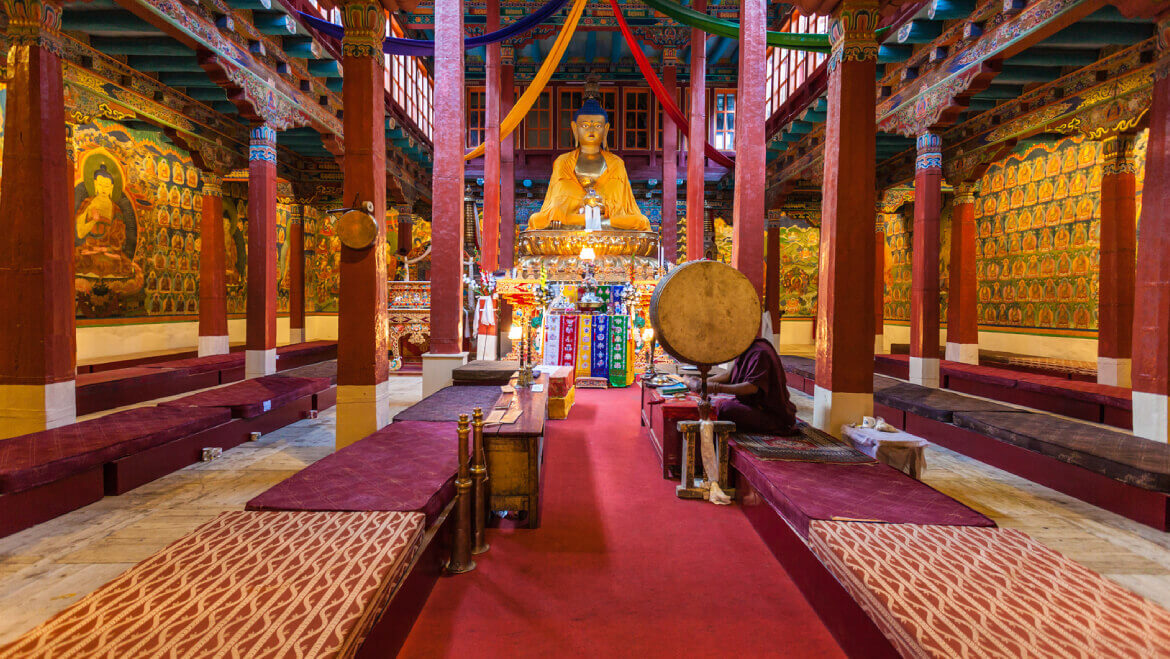
The Hemis Museum is one of the main reasons to allow sufficient time for your visit. It contains an impressive collection of objects linked to the monastery’s history and the wider Buddhist culture of Ladakh.
The exhibits may include thangkas, statues, manuscripts, ritual vessels, ceremonial instruments, jewellery, traditional clothing, masks and weapons.
A museum visit helps travellers understand why Hemis is described as Ladakh’s wealthiest monastery. Many objects demonstrate extraordinary craftsmanship, while others provide insight into religious ceremonies, artistic traditions and relations between monastic institutions and Ladakhi rulers.
Photography is often restricted inside museum galleries. Rules can change, so visitors should check the signs or ask staff before using a camera or mobile phone.
Move slowly through the museum rather than treating it as a quick stop. Labels and displays can reveal details that are easy to miss during a brief visit.
The Famous Hemis Festival
The Hemis Festival, also known as Hemis Tsechu, is one of Ladakh’s most celebrated monastic festivals. It is held in honour of Guru Padmasambhava and follows the Tibetan lunar calendar.
The festival usually takes place on the tenth and eleventh days of the fifth Tibetan month, which means the Gregorian dates change each year. In 2025, it was celebrated on July 5 and 6. Current festival calendars list the 2026 celebration for June 24 and 25, although travellers should reconfirm dates before booking because religious calendars and public schedules can occasionally be updated.
Cham Mask Dances
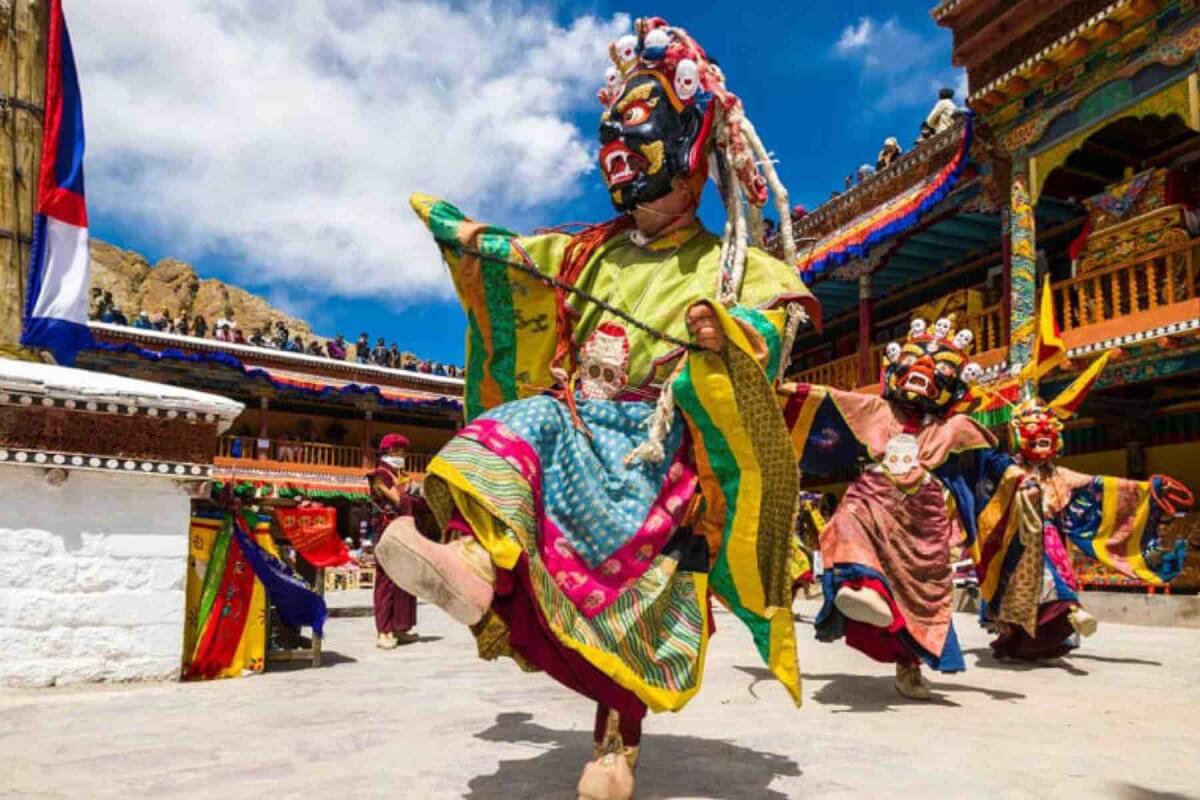
The main attraction is the Cham dance performed by monks wearing elaborate masks and richly decorated robes.
These are not ordinary folk performances created for entertainment. Cham dances are sacred rituals representing Buddhist teachings, spiritual protection and the victory of wisdom over ignorance.
Different masks represent guardians, teachers, animals, spiritual beings and forces that must be overcome on the path towards enlightenment.
The dances are accompanied by drums, cymbals, long horns and other traditional instruments. Their slow, deliberate movements create a hypnotic atmosphere within the monastery courtyard.
Festival Atmosphere
During the festival, Hemis becomes crowded with monks, pilgrims, Ladakhi families, photographers and tourists. Temporary stalls may sell food, handicrafts, souvenirs and religious objects.
Bright clothing, ceremonial music and colourful masks transform the otherwise peaceful courtyard into an energetic cultural gathering.
Arrive early if you want a suitable viewing place. The best positions around the courtyard fill quickly, particularly on the opening morning.
Giant Thangka Display
Hemis Monastery possesses an enormous ceremonial thangka associated with Guru Padmasambhava. Traditionally, this sacred artwork is displayed at long intervals rather than every year, with the major unveiling often linked to a twelve-year cycle.
Because the display schedule is religiously determined, travellers should verify whether any special unveiling is planned instead of assuming it will occur during every Hemis Festival.
Best Time to Visit Hemis Monastery:
The best time to visit Hemis Monastery is generally from May to October, when the roads around Leh are accessible and daytime temperatures are comparatively comfortable.
May and June
Late spring and early summer bring clear mountain views, cool weather and fewer crowds than the busiest weeks of July and August.
Snow may still be visible on high ridges, creating beautiful scenery along the route. June is especially appealing when the Hemis Festival falls during this period.
July and August
These are popular months for Ladakh travel. The days are relatively warm, accommodation options are fully operational and most regional routes are open.
However, Hemis can become busy, particularly during festivals and holiday periods. Start early in the morning to avoid larger tour groups.
Although Ladakh lies in a rain-shadow region, occasional rainfall, road disruptions and changing mountain weather are still possible.
September
September is one of the best months for travellers who prefer clear skies, lighter crowds and pleasant daytime temperatures.
Nights become colder, but road journeys and monastery sightseeing usually remain comfortable during the first part of the month.
October to April
Hemis remains a functioning monastery during winter, but tourism becomes more challenging. Temperatures can fall well below freezing, some facilities close and road travel may be affected by snow or ice.
Winter visitors should confirm road conditions, transport availability and opening arrangements in advance.
Hemis Monastery Timings and Entry Fee
Hemis Monastery is generally open to visitors during daytime hours, often from morning until early evening. However, exact timings may vary according to the season, religious ceremonies, museum schedules and local decisions.
A practical visiting window is between approximately 9:00 a.m. and 5:00 p.m., but travellers should verify the current hours locally before departure.
An entrance or museum fee may be collected at the site. Prices can change, so avoid relying on older blogs or photographs of ticket boards.
Plan at least 90 minutes for a basic visit. Two to three hours are better if you want to explore the prayer halls, museum, courtyard and surrounding area without rushing.
During the Hemis Festival, arrive early and allow most of the day.
How to Reach Hemis Monastery from Leh:
Hemis is easily accessible by road from Leh. The journey generally takes around 1 to 1.5 hours each way, depending on traffic, stops and road conditions.
By Private Taxi
A private taxi is the most convenient option. It allows you to start early, stop for photographs and combine Hemis with other Indus Valley attractions.
A typical monastery circuit may include:
Leh → Shey Palace → Thiksey Monastery → Hemis Monastery → Stakna Monastery → Leh
You can also add Sindhu Ghat or Rancho School, depending on your interests and available time.
Always use a locally permitted vehicle and agree on the itinerary, waiting time and fare before departure.
By Shared Taxi
Shared vehicles may operate towards Karu and nearby settlements, but direct connections to the monastery are less predictable.
This option is cheaper but requires flexibility. You may need to arrange another vehicle from Karu or walk part of the route if no connection is available.
By Local Bus
Government tourism information has listed a bus service from Leh towards Martselang that passes through the Hemis area. Published timings have included a morning departure from Leh and an afternoon return, but local bus schedules can change without much notice. Confirm the service at Leh bus stand before planning your day around it.
By Motorcycle
Experienced riders can visit Hemis by motorcycle. The main road towards Karu is generally straightforward, followed by a narrower approach road after crossing the Indus.
Carry your driving licence, vehicle documents, helmet, water and basic cold-weather protection. Avoid riding immediately after arriving in Leh because altitude-related tiredness can affect concentration.
A Suggested Day Trip to Hemis Monastery
A well-planned Indus Valley monastery tour can include several important attractions without making the day feel hurried.
8:00 a.m.: Leave Leh
Begin after breakfast and drive towards Shey.
8:40 a.m.: Visit Shey Palace
Explore the historic palace and monastery complex, once associated with Ladakh’s royal family.
10:00 a.m.: Visit Thiksey Monastery
Thiksey is one of Ladakh’s most visually impressive monasteries. Its hilltop location and multi-level architecture provide excellent views across the Indus Valley.
12:00 p.m.: Drive to Hemis
Continue towards Karu, cross the Indus and follow the valley road to Hemis.
12:45 p.m.: Explore Hemis Monastery
Visit the courtyard, prayer halls and museum. Allow around two hours.
3:00 p.m.: Lunch
Eat at a local café, monastery restaurant or roadside establishment near Karu, depending on availability.
4:00 p.m.: Optional Stakna Monastery
Visit Stakna Monastery if time and energy permit. Its hilltop position provides sweeping views of the river valley.
6:00 p.m.: Return to Leh
The schedule can be shortened or extended according to monastery timings and road conditions.
Places to Visit Near Hemis Monastery:
Thiksey Monastery
Located between Leh and Hemis, Thiksey is famous for its dramatic hillside architecture, prayer halls and large Maitreya Buddha statue.
Shey Palace and Monastery
Shey served as an earlier royal centre of Ladakh. Its palace ruins, monastery and surrounding landscape make it an important stop on an Indus Valley tour.
Stakna Monastery
Stakna sits on a rocky hill overlooking the Indus River. It is smaller than Hemis and Thiksey but offers an intimate atmosphere and beautiful valley views.
Sindhu Ghat
Sindhu Ghat is a peaceful riverside location near Shey where visitors can spend time beside the Indus River.
Hemis National Park
Hemis National Park is known for its high-altitude landscapes and wildlife, including the elusive snow leopard. However, visiting the monastery is not the same as undertaking a wildlife expedition inside the park.
Proper wildlife trips usually require additional time, local guides, trekking arrangements and seasonal planning. Winter is often considered the key period for specialist snow leopard tracking, while summer is more suitable for trekking and observing the broader landscape.
What to Wear at Hemis Monastery
Wear comfortable, modest clothing suitable for both a religious site and Ladakh’s unpredictable weather.
Recommended items include:
- Full-length trousers or a long skirt
- A shirt or top covering the shoulders
- A light fleece or jacket
- Comfortable walking shoes
- Sunglasses
- Sunscreen
- A hat or cap
- Reusable water bottle
Even during summer, shaded interiors can feel cold. Temperatures may also change quickly when clouds or strong winds move through the valley.
Avoid clothing that is excessively revealing. Remove hats before entering prayer halls when requested.
Monastery Etiquette for Visitors
- A respectful attitude will make your Hemis Monastery visit more meaningful.
- Walk around shrines, stupas and prayer wheels in a clockwise direction unless instructed otherwise. Speak quietly inside prayer halls and avoid interrupting monks during prayers.
- Never touch statues, murals, manuscripts or ritual objects. Do not sit on platforms reserved for monks.
- Ask before photographing monks or local people. Photography may be prohibited inside temples and the museum, even when mobile phones are permitted in the courtyard.
- Avoid using flash around old paintings and textiles. During religious rituals, remain behind designated barriers and follow the instructions of monastery staff.
- Donations are voluntary unless a formal fee is displayed.
High-Altitude Health Tips
- Hemis Monastery is situated at a high altitude, and visitors should acclimatise properly in Leh before undertaking sightseeing trips.
- Spend at least the first 24 to 48 hours resting after arrival, especially if you fly directly from a low-altitude city.
- Drink sufficient water, eat light meals and avoid intense exercise during the first few days. Alcohol and smoking may worsen dehydration and breathlessness.
- Common symptoms of altitude discomfort include headache, nausea, tiredness, poor sleep, dizziness and loss of appetite.
- Do not ignore worsening symptoms. Descending to a lower altitude and seeking medical assistance may be necessary in serious cases.
- Travellers with heart, lung or other medical conditions should consult a qualified doctor before visiting Ladakh.
Travel Tips for Visiting Hemis Monastery
- Start early to enjoy quieter prayer halls and softer light for outdoor photography.
- Carry cash because card machines and digital payments may not always work reliably in remote areas.
- Use sunscreen even on cool or cloudy days. Ladakh’s high altitude increases exposure to ultraviolet radiation.
- Bring drinking water, but avoid leaving plastic waste behind.
- Check monastery and museum timings before departure, especially during winter or religious events.
- Do not combine too many attractions in one day. Thiksey, Shey and Hemis already provide a substantial cultural experience.
- Hire a knowledgeable guide when possible. Buddhist iconography, murals and ritual objects become far more interesting when their symbolism is explained.
- During the Hemis Festival, book hotels and transport well in advance because Leh receives a significant increase in visitors.
- Confirm the annual festival dates from reliable local sources before finalising flights.
Is Hemis Monastery Worth Visiting?
- Hemis Monastery is absolutely worth visiting, especially for travellers interested in Buddhist culture, Himalayan history, sacred art and Ladakhi architecture.
- It offers a different experience from monasteries such as Thiksey, which impresses visitors immediately with its elevated position. Hemis reveals itself more gradually. Its secluded valley, spacious courtyard, shadowy prayer halls and valuable museum create a quieter and more mysterious atmosphere.
- The monastery is also accessible enough to fit into a day trip from Leh without requiring a difficult trek or special permit.
- Visitors attending the Hemis Festival will encounter the monastery at its most colourful and energetic. Those visiting on an ordinary day may have a more peaceful experience and more time to appreciate the architecture and religious atmosphere.
- Both experiences are rewarding in different ways.
Frequently Asked Questions About Hemis Monastery
Why is Hemis Monastery famous?
Hemis Monastery is famous for its association with the Drukpa lineage, its valuable collection of Buddhist art, its museum and the annual Hemis Festival featuring sacred Cham mask dances.
Is Hemis the oldest monastery in Ladakh?
No. Although it is often described online as the oldest monastery in Ladakh, the present Hemis Monastery mainly dates to the 17th century. Monasteries and temple complexes with earlier origins exist elsewhere in Ladakh.
Is Hemis the richest monastery in Ladakh?
Hemis is widely regarded as one of the richest monasteries in Ladakh because of its extensive collection of manuscripts, thangkas, statues, ritual objects and historic treasures.
How far is Hemis Monastery from Leh?
Hemis is approximately 40 to 45 kilometres southeast of Leh. The drive usually takes around 1 to 1.5 hours.
How much time is needed at Hemis Monastery?
Allow at least 1.5 hours. Two to three hours are recommended if you plan to visit the museum and explore the complex properly.
Can Hemis be visited with Thiksey Monastery?
Yes. Hemis, Thiksey and Shey are commonly included in the same Indus Valley sightseeing tour.
When is the Hemis Festival held?
The Hemis Festival follows the Tibetan lunar calendar, so its dates change each year. It normally takes place during the summer and lasts two days.
Are tourists allowed inside the monastery?
Yes, tourists can enter designated courtyards, prayer halls and museum sections after purchasing any required ticket. Certain private or religious areas may remain closed.
Is photography allowed?
Photography is generally permitted in the courtyard and outdoor spaces. It may be restricted inside prayer halls and museum galleries. Always check signs or ask permission.
Do visitors need a permit to visit Hemis Monastery?
Hemis Monastery itself normally does not require the special permits needed for some border areas of Ladakh. Travellers should still carry valid identification and follow any current local regulations.
Recommended Ladakh Travel Articles:
- Ladakh in August 2026: Weather, Road Routes and Travel Tips
- Lamayuru Monastery Guide: History, Attractions and Visiting Tips
- Ladakh in June 2027: Weather, Open Roads and Places to Visit
- Thiksey Monastery Leh Ladakh: History, Highlights and Visitor Guide
- Zanskar Valley Ladakh Guide: Places to Visit, Routes and Tips
- Nubra Valley Ladakh Travel Guide: Best Places, Routes and Tips
- Ladakh Trip Cost Guide: Budget, Stay, Transport and Travel Advice
- Ladakh Inner Line Permit Guide: Documents, Rules and Restricted Areas
- Ladakh in May 2027: Weather, Road Conditions and Travel Tips
- Apricot Blossom Festival Ladakh: Dates, Villages and Visitor Guide
- Ladakh Silk Route Travel Guide: History, Villages and Scenic Drives
- Ladakh in April 2027: Weather, Temperature and Travel Advice
- Magnetic Hill Ladakh Guide: Location, Mystery and Travel Tips
- First-Time Ladakh Guide: Best Routes, Itinerary and Travel Tips
- Leh Ladakh in January 2027: Weather, Snowfall and Winter Guide
- Karakoram Wildlife Sanctuary Guide: Nubra Valley, Shyok and Wildlife
- Pangong Lake Ladakh Guide: Route, Best Time and Travel Tips
- Magnetic Hill Ladakh: Scientific Facts, Myths and Visitor Guide
- Shanti Stupa Leh Guide: History, Timings and Travel Tips
- How to Reach Ladakh by Air, Road, Train and Bike
- AMS in Ladakh Guide: Symptoms, Prevention and Acclimatisation Tips
- Stok Kangri Trek Guide: Route, Altitude, Difficulty and Tips
- Zoji La Pass Travel Guide: Route, Weather and Road Conditions
- Ladakh in July 2026: Weather, Road Trips and Places to Explore
- Best Photography Places in Ladakh for Mountain and Landscape Views
- Hemis Festival 2026 Guide: Dates, Rituals and Travel Tips
- New Year in Leh Ladakh 2026: Weather, Snowfall and Travel Guide
- Ladakh Helicopter Service Guide: Routes, Booking and Travel Updates
Final Thoughts
Hemis Monastery is one of the finest places to experience Ladakh’s spiritual and cultural heritage. Its importance goes beyond its reputation as the richest monastery in Ladakh. It remains a living Buddhist institution where monks study, rituals continue and centuries-old artistic traditions are preserved.
The journey from Leh through the Indus Valley offers beautiful scenery, while the monastery’s hidden setting creates a sense of discovery. Inside, visitors encounter a vast courtyard, atmospheric prayer halls, colourful paintings and a museum filled with remarkable cultural treasures.
Although Hemis is not literally the oldest monastery in Ladakh, it is unquestionably among the region’s most historic and influential religious centres. Its royal connections, Drukpa heritage, sacred collection and famous festival have given it a unique position within Ladakhi Buddhism.
Visit during the Hemis Festival for vibrant masks, ceremonial music and extraordinary cultural energy. Visit on a quieter day for meditation, architecture and unhurried exploration.
Either way, Hemis Monastery deserves a prominent place in any thoughtfully planned Ladakh itinerary.