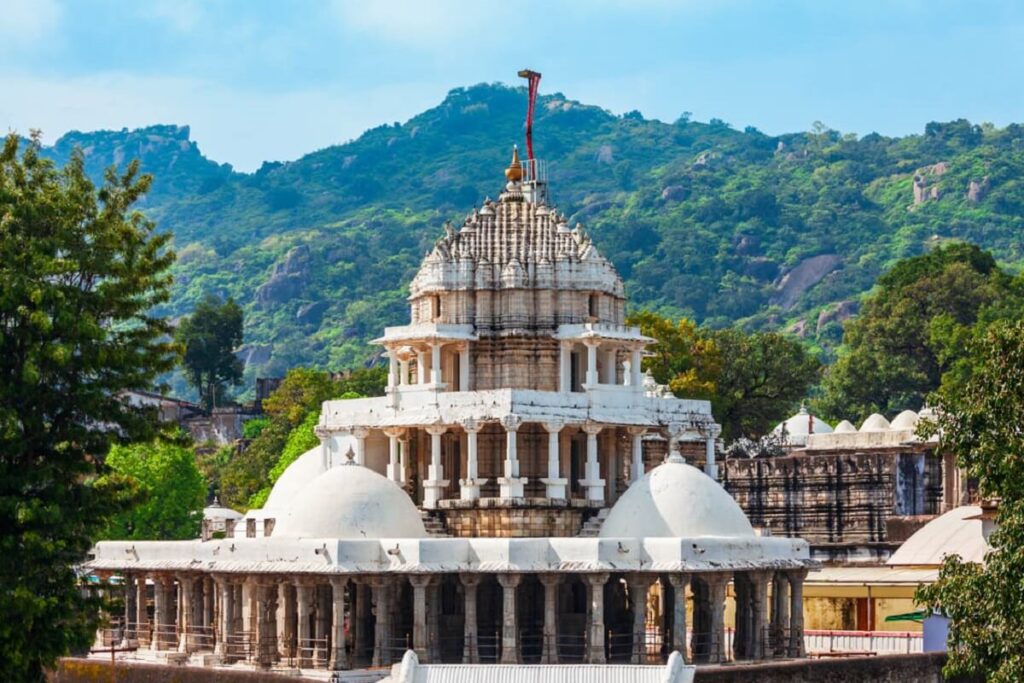
The Dilwara Temples of Mount Abu are among the most extraordinary religious monuments in India. Revered by Jain devotees and admired by historians, architects, and travelers alike, these temples represent the highest achievement of Jain marble architecture in the medieval period. Located quietly in the forested hills of the Aravalli Range near Mount Abu, Rajasthan, the Dilwara Temple complex is not just a group of sacred shrines but a living archive of faith, craftsmanship, and cultural continuity.
Built between the 11th and 16th centuries, the Dilwara Temples are famous worldwide for their breathtaking white marble carvings, where every inch of stone appears delicately chiseled by hand. Unlike many monumental temples of India, their outer structures are intentionally plain, reflecting Jain ideals of simplicity and restraint. Step inside, however, and visitors encounter a world of unmatched artistic brilliance. Pillars bloom with carved lotus flowers, ceilings ripple with celestial patterns, and figures of dancers, gods, and mythological beings emerge from marble with astonishing realism.
This detailed guide explores the history of the Dilwara Temples, their architectural evolution, the patrons who commissioned them, the symbolism behind their art, and their importance as a Jain pilgrimage site. Whether you are a history enthusiast, a spiritual traveler, or someone researching Mount Abu’s cultural heritage, this comprehensive account offers everything you need to understand why the Dilwara Temples remain timeless masterpieces.
Location and Historical Context of the Dilwara Temples
The Dilwara Temples are located about 2.5 kilometers from Mount Abu town, Rajasthan’s only hill station. Surrounded by dense forests and rocky terrain, the site was deliberately chosen to provide isolation and tranquility. For Jains, spiritual progress is closely linked to detachment from worldly distractions, and the calm environment of Dilwara aligns perfectly with this philosophy.
During the medieval period, Mount Abu sat near the borderlands of Gujarat and Rajasthan, making it a culturally active region. Several Hindu dynasties ruled this area, including the Solankis (Chalukyas) and later the Vaghelas, under whose reign Jain ministers gained significant administrative and commercial power. Although the rulers were Hindu, Jain officials played crucial roles in governance and trade, allowing them to accumulate wealth and patronize religious institutions.
The Dilwara Temples were not royal constructions. Instead, they were commissioned by wealthy Jain laymen, particularly ministers and merchants, who viewed temple building as an act of spiritual merit. This distinction is important because it explains the temples’ modest exteriors and deeply spiritual interiors. The goal was not political display but religious devotion.
Origins and Construction Timeline of the Dilwara
Temples
The construction of the Dilwara Temple complex unfolded gradually over nearly five centuries, reflecting the sustained commitment of Jain patrons across generations.
Early Beginnings in the 11th Century
The earliest temple, Vimal Vasahi, was commissioned around 1031 CE during the reign of Solanki king Bhima I of Gujarat. This period saw significant Jain patronage across western India, particularly in temple architecture and manuscript production.
Expansion in the 13th Century
The second major phase of construction occurred in the early 13th century, when two brothers, Vastupala and Tejapala, emerged as influential ministers under the Vaghela dynasty. Their contribution elevated the Dilwara complex to new artistic heights.
Later Additions from the 14th to 16th Centuries
Subsequent centuries saw additional temples built and existing structures expanded or restored. These later constructions reflect changes in artistic style while maintaining continuity with earlier traditions.
Explore Itineraries for Mount Abu:
- 3 Days Mount Abu Tour Package for Families & Couples
- 3 Days Mount Abu with Kumbhalgarh Fort Tour
- 5 Days Udaipur and Mount Abu Sightseeing Trip
- 12 Days Complete Rajasthan Tour with Mount Abu Hill Station
Key Patrons and Builders of the Dilwara Temples
Several prominent Jain patrons were instrumental in shaping the Dilwara complex.
Vimal Shah
Vimal Shah was a powerful minister in the court of King Bhima I of the Solanki dynasty. A devout Jain, he commissioned the Vimal Vasahi Temple, dedicating it to Rishabhanatha, the first Tirthankara. His temple set the architectural and artistic foundation for all later constructions at Dilwara.
Vastupala and Tejapala
These brothers served as ministers to King Virdhaval of the Vaghela dynasty. Known for their administrative skills and religious devotion, they built the Luna Vasahi Temple in memory of their late brother Lunig. Their temple is often considered the most refined in the entire complex.
Bhima Shah
A Jain minister serving the Sultan of Ahmedabad, Bhima Shah oversaw the construction of the Pittalhar Temple in the 14th century. His contribution reflects the continued patronage of Jain institutions even under Islamic rule.
The Mandlik Family
In the 15th century, the Mandlik family commissioned the Parshvanatha Temple, using recycled stone from older structures. Their work demonstrates adaptability and continuity during a period of political change.
The Māru-Gurjara Architectural Style
The Dilwara Temples are prime examples of the Māru-Gurjara style, also known as the Solanki style. This architectural tradition originated in Gujarat and Rajasthan and is characterized by:
- Highly ornate interiors
- Finely carved marble pillars
- Elaborate ceilings with concentric designs
- Clustered shikharas or spires
- Intricately sculpted toranas or gateways
Unlike many temple styles that emphasize towering exteriors, Māru-Gurjara architecture focuses on interior detail, aligning closely with Jain spiritual values.
The Five Dilwara Temples Explained in Detail:
Vimal Vasahi Temple (1031 CE)
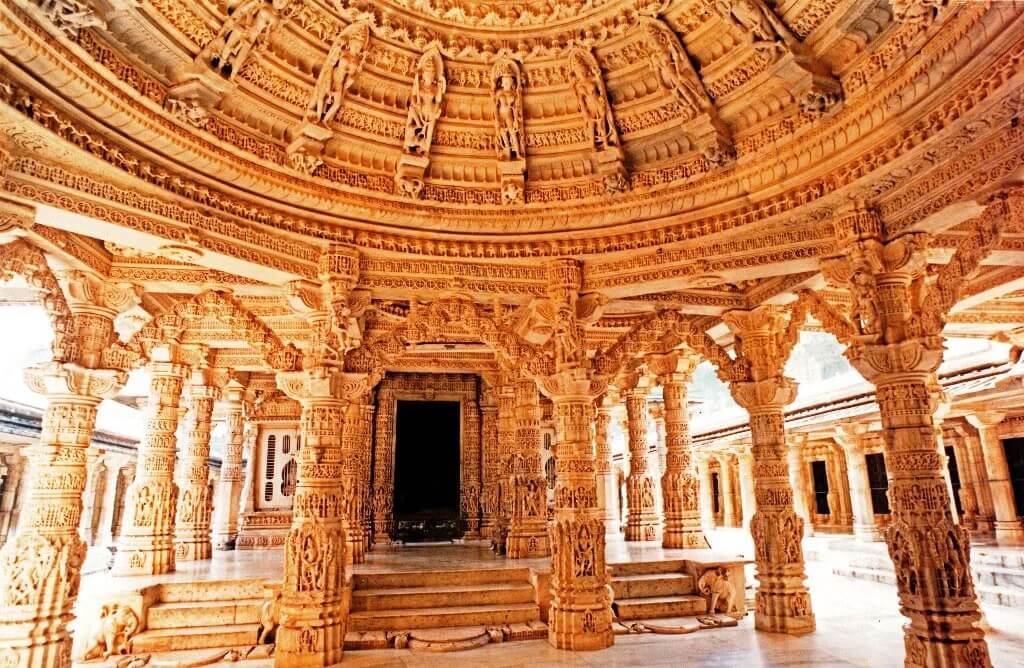
The Vimal Vasahi Temple is the oldest and one of the most important temples in the complex. Dedicated to Rishabhanatha, the first Jain Tirthankara, it represents the beginning of Jain marble architecture at Dilwara.
The temple features a rectangular courtyard surrounded by 59 subsidiary shrines, each housing an image of a Tirthankara. The central sanctum contains a rare Panchtirthi idol, depicting five forms of Rishabhanatha.
The ceilings are adorned with lotus designs symbolizing purity and spiritual awakening. An elephant courtyard known as Hastishala was added later, featuring marble sculptures of elephants carved with extraordinary realism.
Luna Vasahi Temple (1230 CE)
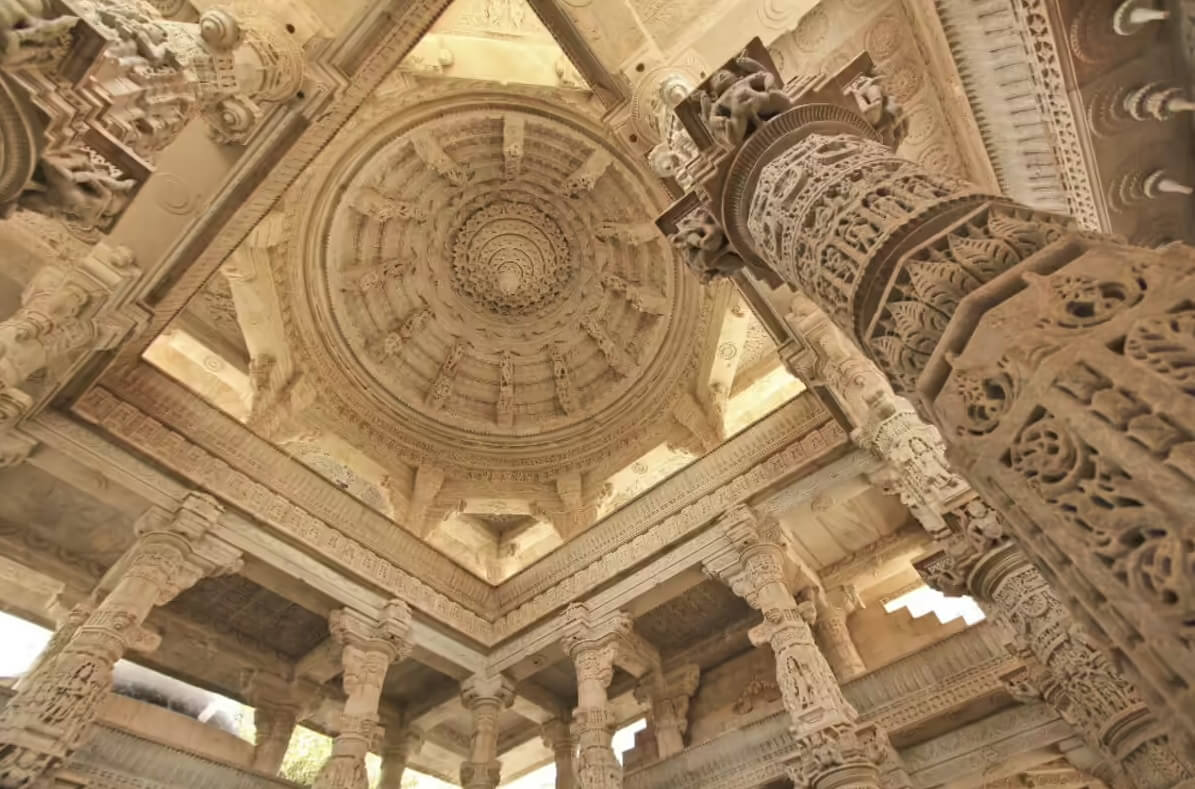
Often regarded as the artistic peak of the Dilwara Temples, the Luna Vasahi Temple is dedicated to Neminatha, the 22nd Tirthankara. Built by Vastupala and Tejapala, it surpasses even Vimal Vasahi in complexity and refinement.
Its most celebrated feature is the central dome, decorated with a pendant lotus that appears to hang effortlessly from the ceiling. Surrounding this dome are 72 intricately carved Tirthankara figures.
The Navchowki halls depict scenes from Neminatha’s life, offering both devotional and narrative value. A Kirti Stambha added in the 15th century further enhances the temple’s grandeur.
Pittalhar Temple (14th–15th Century)
The Pittalhar Temple is unique for its massive brass idol of Adinatha, weighing over three tons. Unlike the marble focus of other temples, this shrine highlights Jain metal casting traditions.
Although parts of the temple remain unfinished, it contains 107 sacred images, reflecting the ambition of its patron, Bhima Shah. The scale of the idol symbolizes strength, permanence, and spiritual authority.
Parshvanatha Temple (1458–1459 CE)
Dedicated to Parshvanatha, the 23rd Tirthankara, this three-story temple is notable for its chaumukha design, allowing worship from four directions.
Carved from grey sandstone, the temple features detailed depictions of the 14 auspicious dreams seen by the Tirthankara’s mother before his birth. Guardian deities known as dikpalas appear in dynamic poses, adding movement to the otherwise meditative space.
Mahavira Swami Temple (1582 CE)
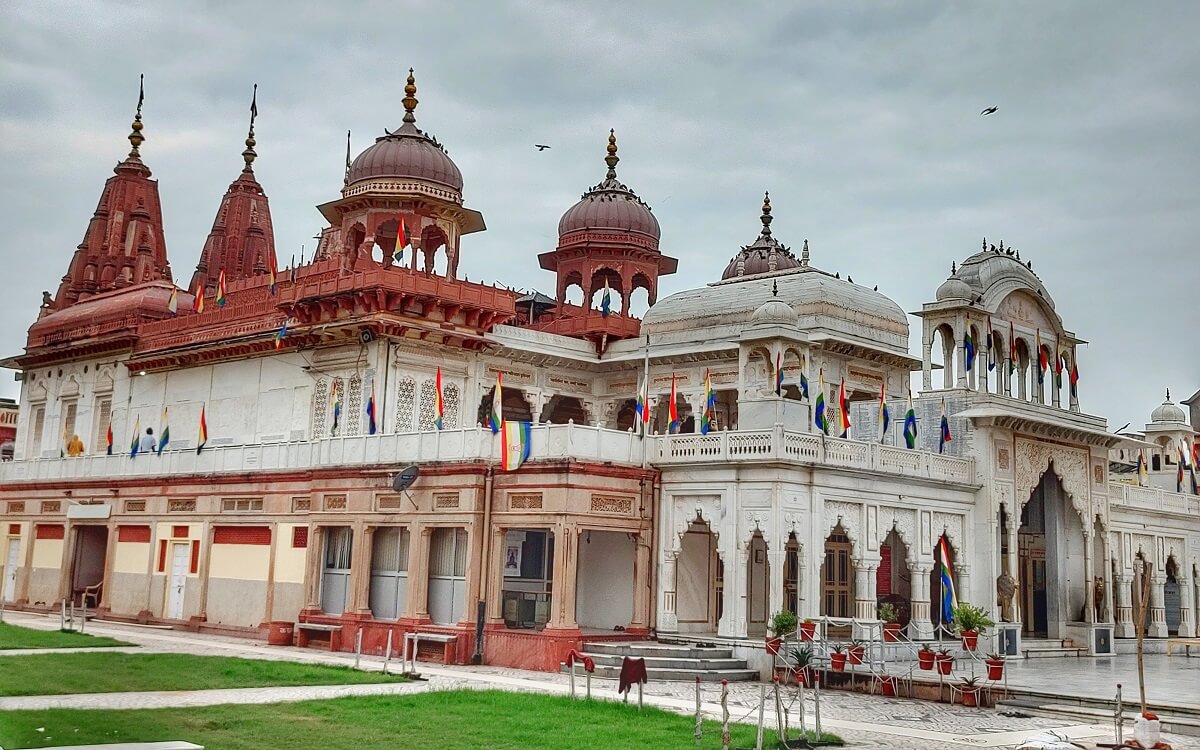
The youngest and smallest of the five, the Mahavira Swami Temple honors the 24th Tirthankara, Mahavira. Built during the Mughal era, it reflects a subtle shift in artistic themes.
Its walls depict courtly scenes, musicians, and floral patterns. A painted porch added in the 18th century illustrates Jain narratives, while a marble slab outside displays 133 miniature Tirthankara carvings.
Symbolism and Spiritual Meaning in Dilwara Temple Art
Every carving inside the Dilwara Temples serves a symbolic purpose. Lotus flowers represent spiritual purity. Celestial dancers reflect cosmic harmony. Repeated geometric patterns suggest infinity and the eternal nature of the soul.
The temples function as visual scriptures, teaching Jain philosophy through art. Pilgrims learn about ahimsa (non-violence), renunciation, and moksha (liberation) by observing these carvings during darshan.
Cultural Importance and Jain Pilgrimage Significance
The Dilwara Temples are among the most important Śvētāmbara Jain pilgrimage sites in India. Devotees believe that visiting the temples helps cleanse karma and advance spiritual growth.
Their importance extends beyond religion. Scholars consider them among the finest marble structures ever built, often comparing their craftsmanship to lacework in stone.
Historical Challenges, Damage, and Restoration Efforts
The temples suffered damage during Alauddin Khilji’s invasion in 1311, though repairs were carried out soon after. Natural aging also took its toll over centuries.
Major restoration efforts occurred in 1906 and later between 1950 and 1965, led by the Anandji Kalyanji Trust, which sourced fresh marble from Makrana, the same quarries used during the original construction.
Today, the complex is managed by the Seth Kalyanji Paramanandji Pedi Trust, ensuring preservation while allowing public access.
Visiting the Dilwara Temples Today
The temples are open to visitors of all faiths, though strict rules apply. Photography is prohibited inside, leather items are not allowed, and modest dress is required.
The best time to visit is during early morning hours when crowds are lighter and the marble interiors glow softly in natural light.
Conclusion: Why the Dilwara Temples Matter Today
The Dilwara Temples are not relics of the past. They are living expressions of faith, discipline, and artistic excellence. For over eight centuries, they have stood quietly in the Aravalli hills, reminding visitors that true grandeur does not lie in size or spectacle, but in devotion, detail, and timeless beauty.
Whether approached as a spiritual journey, a historical study, or a travel experience, the Dilwara Temples continue to inspire awe, making them one of India’s most profound architectural treasures.
Check More:
- Mount Abu Winter Festival 2025 | Culture & Celebration
- Mount Abu in January 2026: Weather, Top Sightseeing & Travel Advice
- Best Places to Visit in Rajasthan in January 2026: Weather & Trip Ideas
- Visiting Rajasthan in February 2026: Weather, Top Destinations & Travel Guide
- How to Reach Mount Abu from Delhi: Road, Train & Flight Options Explained
- Mount Abu in July 2026: Weather, Best Attractions & Travel Tips
- How to Reach Mount Abu from Ahmedabad: Best Routes, Travel Time & Tips
- Things to Do in Jawai, Rajasthan: Wildlife Safaris, Culture & Travel Guide
- Things to Do in Mount Abu: A Complete Guide to Rajasthan’s Only Hill Station