Mandu is the kind of place where ruins still whisper. Perched high on the Malwa plateau in Madhya Pradesh, this ancient hilltop capital is surrounded by lakes, ravines, and green plains. The air feels charged with history—sometimes with the roar of forgotten courts, sometimes with the soft notes of a love song carried on the wind.
Unlike many crowded heritage sites in India, Mandu feels open, quiet, and almost dreamlike. You can wander from one palace to another, step into empty halls where music once echoed, and look out from pavilions that still guard the horizon. What sets Mandu apart is not just the scale of its monuments but the poetry woven into them. Every structure seems to balance function and romance.
For travelers seeking a blend of history, architecture, and storytelling, Mandu is a treasure. The city may not enjoy the same fame as Agra or Jaipur, but those who visit quickly understand its magic. If you’re planning your trip around the seasons, guides like India weather by month or safe offbeat travel post monsoon can help you choose the right time. Winter and post-monsoon are best, and if you’re nearby in Indore or Ujjain, resources such as day trips from Ujjain, Omkareshwar and Mandu will make it easy to include Mandu in your journey.
A Brief History of Mandu
Mandu was originally built as a fortress. Its cliffs rise sharply from the plain, making the city naturally secure. In the 14th century, Afghan rulers of the Malwa Sultanate made it their capital. They brought with them a taste for bold, simple architecture—arches, domes, thick walls, and large open courtyards.
Over time, Mandu grew beyond its military purpose. It became a city of art, music, and poetry. The most famous story belongs to Sultan Baz Bahadur and Rani Roopmati, whose romance transformed Mandu into a city of legend. He was a patron of the arts and she was a singer whose beauty inspired generations of songs. Their story still shapes how visitors see Mandu today.
This mix of military might, Afghan design, and romantic lore is what makes Mandu special. Unlike other forts where war stories dominate, here the tales are often about music, devotion, and beauty. If you want to see how Mandu fits into Madhya Pradesh’s cultural landscape, take a look at the complete guide to UNESCO heritage monuments in MP.
What Makes Mandu’s Architecture Unique?
Several features set Mandu’s monuments and palaces apart from other historic cities in India:
- Blending of styles: Afghan arches and domes mix with local Hindu details, creating buildings that are both strong and graceful.
- Use of water: Tanks, lakes, and channels cool the air and reflect light, giving Mandu’s palaces a sense of floating beauty.
- Natural defenses: The entire city is perched on a plateau with cliffs and ravines. Architects used the terrain as part of their design.
- Acoustics: Many halls were tuned for performance. Even today, a soft clap or a line of music echoes beautifully inside them.
- Romance in stone: Unlike many forts, Mandu celebrates love as much as power. Roopmati’s Pavilion, for instance, is less about defense and more about a lover’s view of the Narmada river.
Jahaz Mahal: The Floating Palace

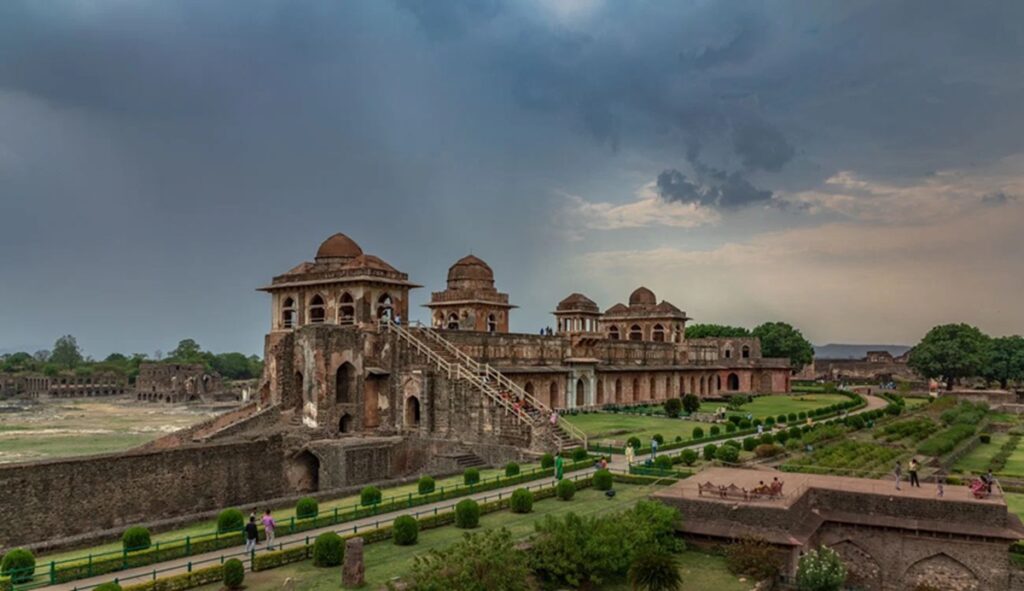
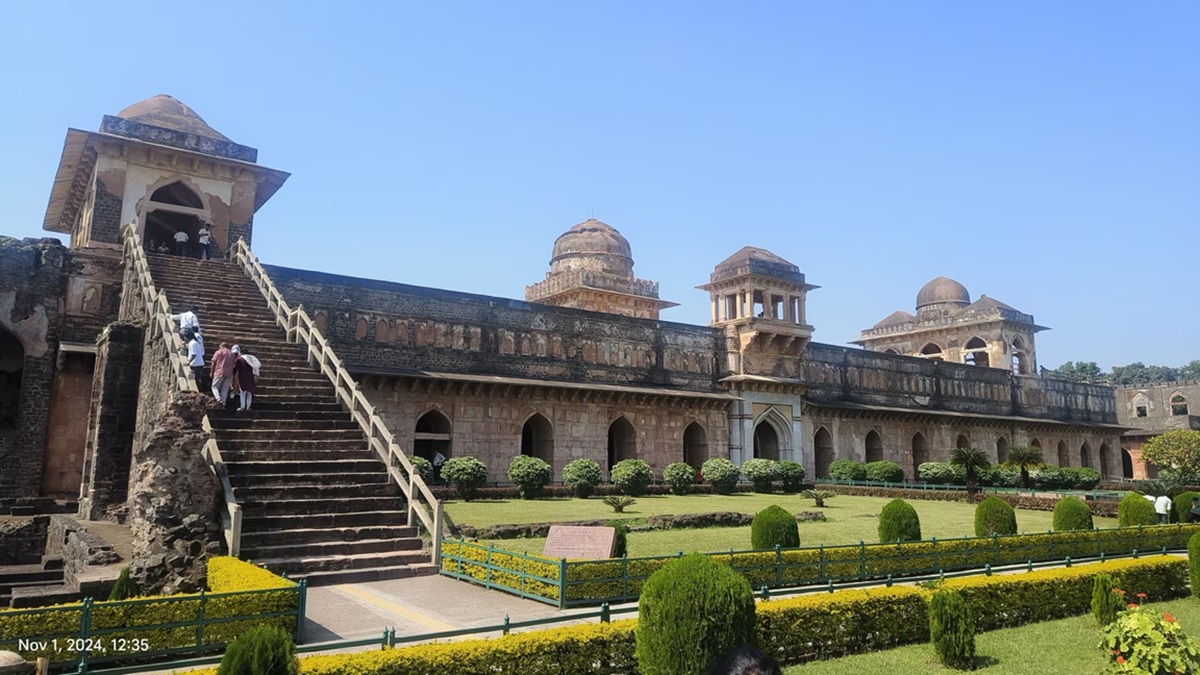
Perhaps the most iconic monument of Mandu is the Jahaz Mahal, or Ship Palace. Built on a narrow strip of land between two lakes, Munj Talao and Kapur Talao, the structure looks like a great vessel anchored in water.
The palace was designed in the 15th century as a pleasure resort, with airy pavilions, long corridors, and tanks to store rainwater. From the roof, the reflections of water on either side create the illusion of a floating ship.
Highlights for visitors:
- The roof terrace offers sweeping views of the lakes, especially at sunset.
- Intricate channels once carried water to cool the palace in summer.
- The symmetry of arches and domes creates a rhythm that feels almost musical.
If you plan your trip around cooler months, the courtyard and terraces are more comfortable. For seasonal ideas, see places to visit in Madhya Pradesh in December or the larger India weather in December guide.
Hindola Mahal: The Swinging Palace
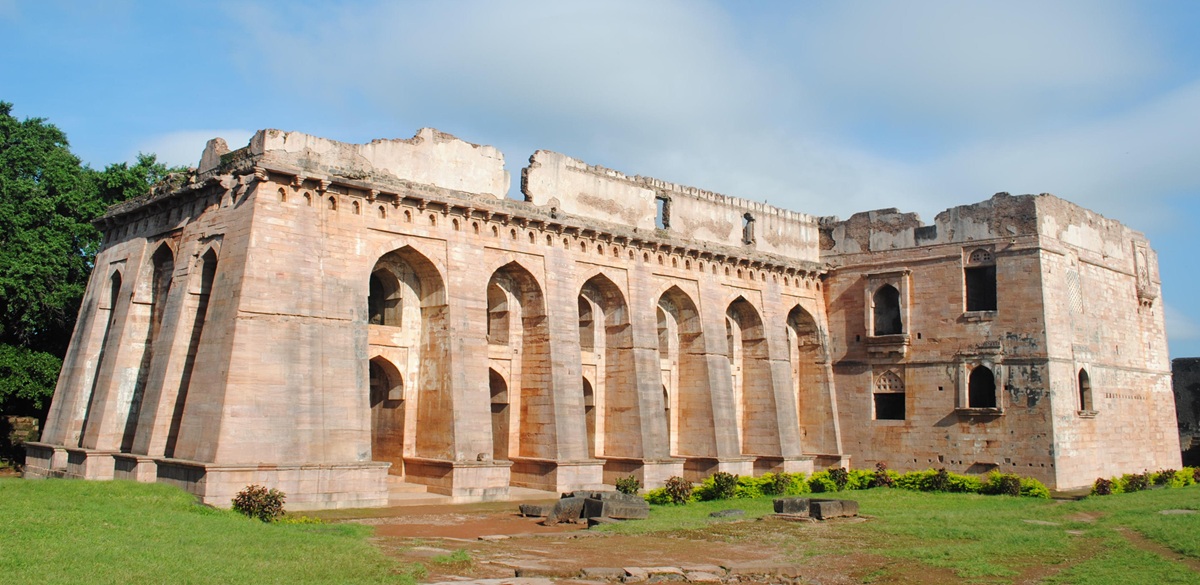
Close to Jahaz Mahal stands the Hindola Mahal, or Swing Palace. It is one of Mandu’s most unusual structures, named for its sloping walls that lean inward like the sides of a swing.
The hall is vast, with pointed arches stretching in a line. Historians believe it was an assembly hall, where sultans addressed their court. Its design, though simple, is striking. The sloping walls not only give it stability but also create a dramatic perspective when you stand at one end.
Why it’s unique:
- The architecture is minimal yet bold.
- Acoustics inside are excellent, carrying voices clearly across the hall.
- The design demonstrates Afghan engineering adapted to Indian conditions.
Hindola Mahal is best visited in the late afternoon when sunlight streams through the arches, casting long shadows. Monsoon adds greenery to the surroundings, making it even more photogenic. If you enjoy such atmospheric ruins, you might also enjoy exploring historical forts in India during monsoon.
Rani Roopmati’s Pavilion: A View of Love
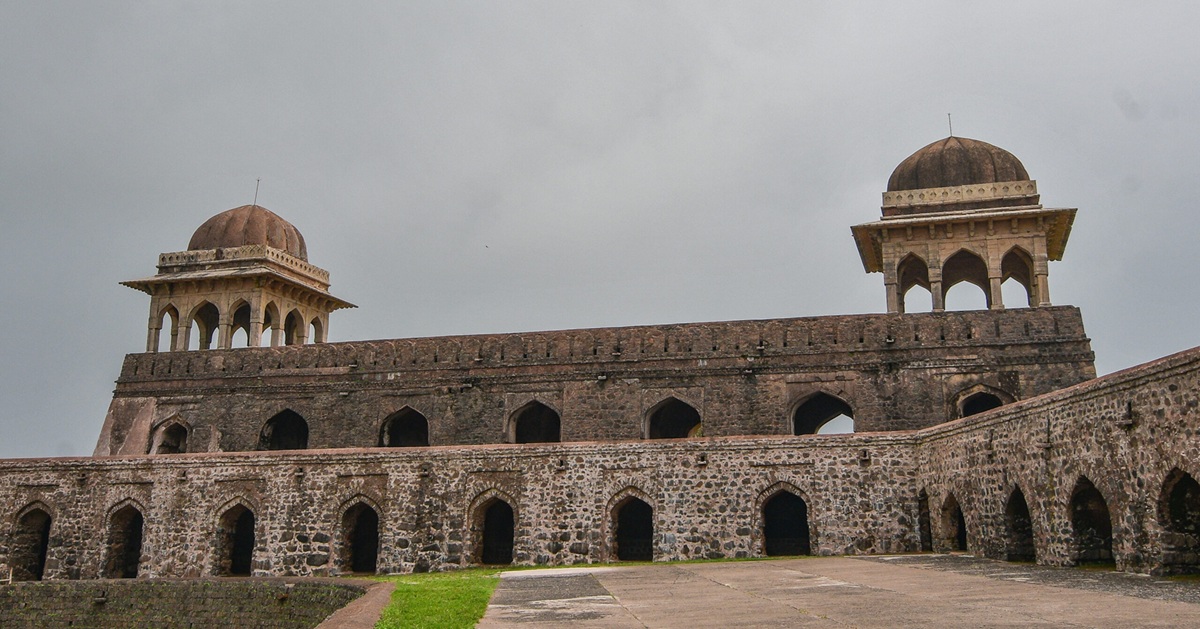
Few places in India capture romance as vividly as Rani Roopmati’s Pavilion. Perched at the southern edge of the Mandu plateau, it overlooks the Narmada valley. Tradition says that Roopmati, beloved of Sultan Baz Bahadur, would gaze from here at the river each day while singing.
The twin domed pavilions on the roof frame the horizon beautifully. The view is especially stunning at sunset, when the sky turns gold and the valley fades into mist. The breeze rising from the plains makes it a naturally cool spot, even on warm afternoons.
For couples, this is one of the most poetic places to visit in Madhya Pradesh. To plan a romantic itinerary across India, you might also want to check this list of romantic places to visit in April.
Baz Bahadur’s Palace: Music in Stone
Directly below Roopmati’s Pavilion lies Baz Bahadur’s Palace. Unlike Jahaz Mahal, this palace is not about scale—it is about proportion and sound. With wide courtyards, colonnaded verandahs, and a central tank, the design feels tuned for performance.
Local guides often demonstrate how the halls carry sound. Even a single note sung under the dome reverberates beautifully. It is said that music concerts and poetry gatherings were once held here, with Roopmati herself performing.
Key features to notice:
- The palace frames views of Roopmati’s Pavilion above.
- Carved stone brackets and doorways show simple but refined details.
- The central courtyard acts as both gathering place and acoustic chamber.
This palace is best enjoyed when the crowds are thin—try early mornings or late afternoons. If you’re planning an April trip in this region, the Madhya Pradesh in April travel guide gives practical weather and itinerary suggestions.
Jami Masjid and Hoshang Shah’s Tomb
The Jami Masjid of Mandu reflects Afghan simplicity inspired by the great mosque of Damascus. Built on a high platform, it features a vast courtyard, domed prayer halls, and red sandstone walls that glow in sunlight.
Nearby stands Hoshang Shah’s Tomb, India’s first marble mausoleum. Its clean lines and dome are believed to have influenced the architects of the Taj Mahal in Agra. Walking inside, the cool marble and soft light create a mood of calm reverence.
Why these structures stand out:
- They represent the more spiritual, sober side of Mandu, balancing the romance of the palaces.
- The marble craftsmanship at Hoshang Shah’s Tomb is considered a prototype for later Mughal designs.
- Together, they showcase the city’s cultural and religious diversity.
For a complete cultural loop, visit Ashrafi Mahal and Champa Baoli nearby. If you’re combining Mandu with Khajuraho, this detailed guide to Khajuraho entry fees and activities will help with planning.
Water, Wind, and Sound: The Secrets of Mandu’s Design
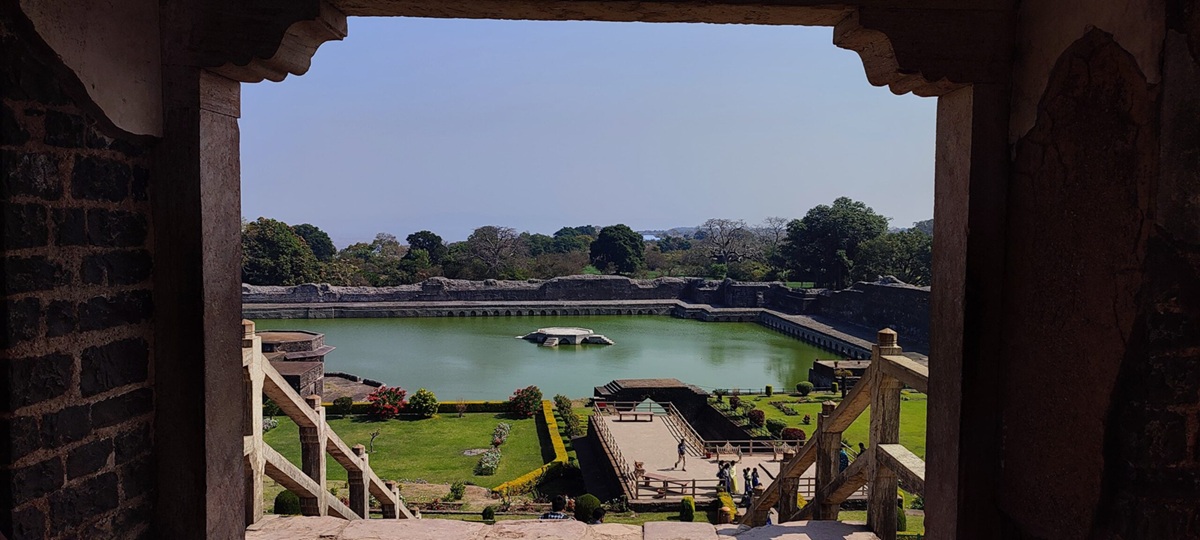
The monuments of Mandu share three hidden threads:
- Water as design: Tanks and lakes were not just for storage. They cooled the air, reflected facades, and gave Mandu its unique floating palaces.
- Wind as guest: Pavilions and high terraces were oriented to capture breezes, keeping spaces cool without modern systems.
- Sound as architecture: Many halls were designed with acoustics in mind, amplifying voices for court, prayer, or performance.
Together, these elements make Mandu feel alive. Even as ruins, the palaces breathe, whisper, and sing.
Ashrafi Mahal and Champa Baoli: Layers of Learning and Life
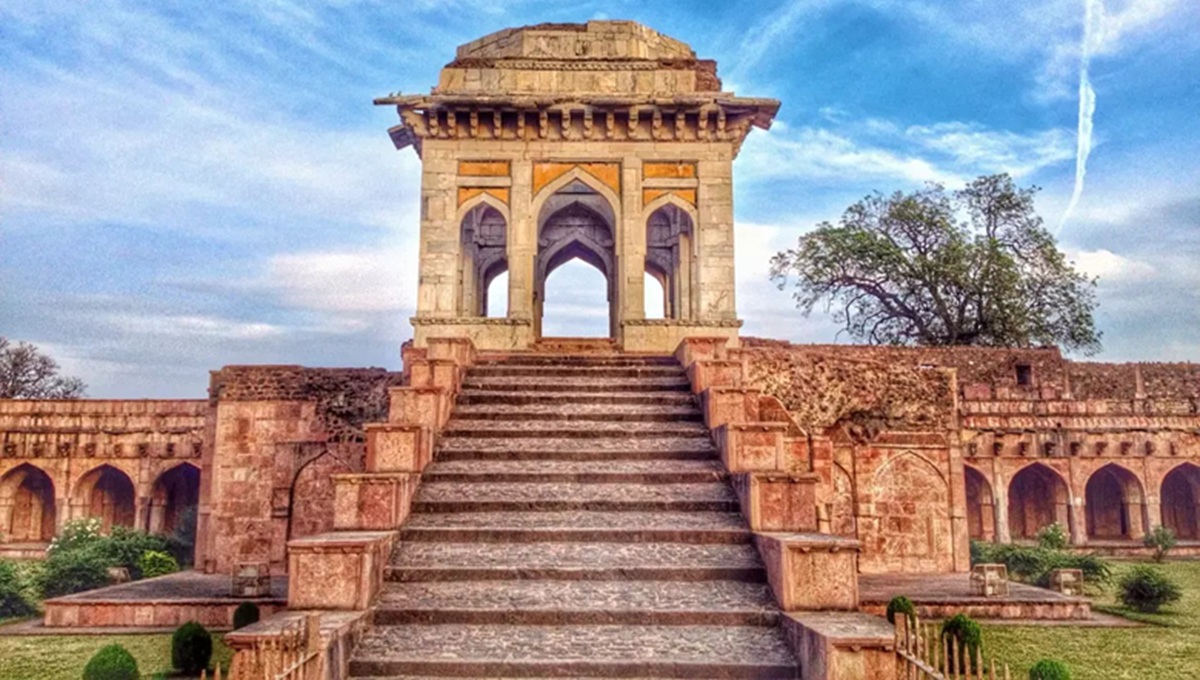
While palaces and pavilions take most of the limelight, Mandu also has quieter corners that reveal its layered history.
Ashrafi Mahal once served as a madrasa (Islamic school) and later as a grand tower built to commemorate victory. Today only ruins remain, but you can still trace the outlines of classrooms and courtyards. Its crumbling arches and columns speak of the city’s intellectual life—Mandu was not only about music and romance, it was also a center of learning.
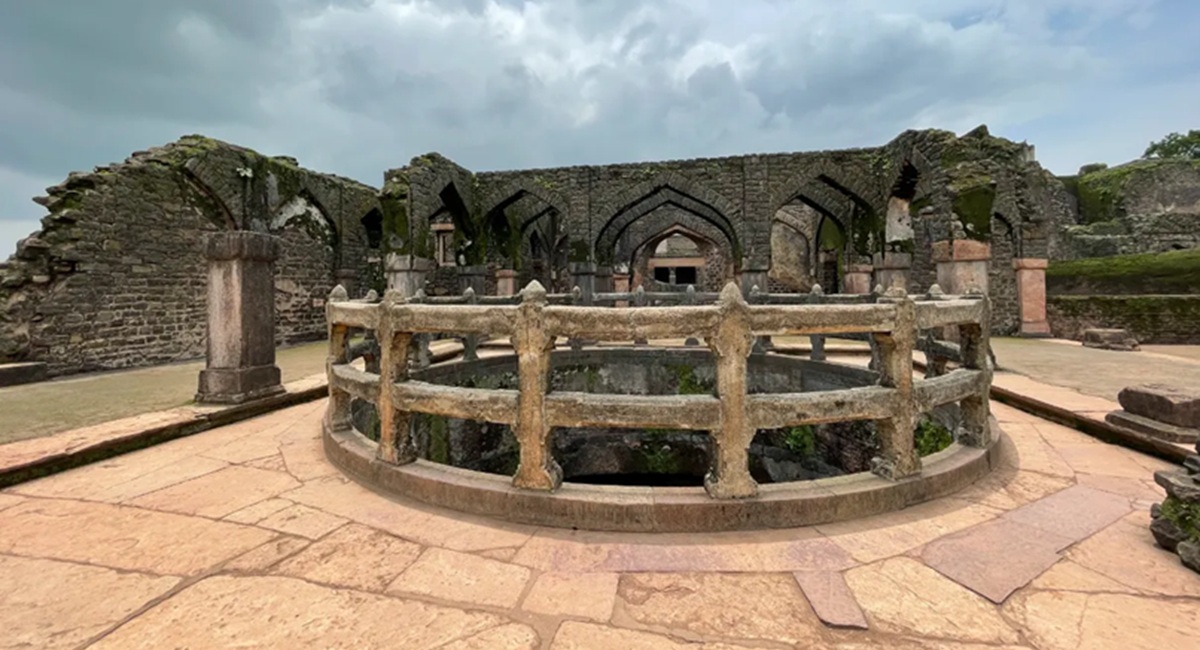
Nearby, Champa Baoli is a stepwell that goes deep into the ground. The cool air inside earned it the name “Champa,” as it was said to smell as sweet as the champa flower. This subterranean design shows how Mandu’s builders used clever water storage systems to survive on the plateau. Stepwells like this also served as social spaces where people gathered, traded stories, and found relief from the heat.
Echo Point and the Acoustics of Mandu
One of Mandu’s unique tricks lies in how sound travels across its monuments. The city is filled with “echo points” where a shout bounces back from walls or across courtyards. In the empty assembly halls and wide pavilions, even a soft clap creates a ripple. This was no accident—architects designed vaults and walls to carry sound, making them perfect for prayers, music, and performances.
Travelers love to test these acoustics at Hindola Mahal or Baz Bahadur’s Palace. Children laugh as their voices echo, and singers often hum a line of melody just to feel the halls respond.
Legends and Love Stories of Mandu
Mandu would be incomplete without its most enduring story—the romance of Baz Bahadur and Rani Roopmati. He was the last independent Sultan of Malwa, known for his passion for music. She was a singer from a humble background, whose voice captivated him.
Their love gave birth to two of Mandu’s most beautiful monuments: Roopmati’s Pavilion and Baz Bahadur’s Palace. But the tale ended tragically when Mughal forces invaded. Baz Bahadur fled the battlefield, and Roopmati, unwilling to be captured, chose to end her life.
Even today, the wind that rises over Roopmati’s Pavilion feels like part of this legend. Locals recount their story with pride, reminding visitors that Mandu is as much a city of love as it is of stone.
Exploring Mandu Today
Visiting Mandu is a journey into the past, but it’s also a comfortable trip for modern travelers. The town is about 95 km from Indore, which has the nearest airport and train links. Roads are good, and you can easily make Mandu part of a day trip from Indore or Ujjain—see this detailed list of day trips from Ujjain, Omkareshwar, and Mandu for practical circuits.
Suggested Circuits
- Royal Enclave: Jahaz Mahal, Hindola Mahal, Champa Baoli.
- Sagar Talao group: Smaller palaces and tanks around the lake.
- Baz Bahadur and Roopmati circuit: The romantic highlights.
- Religious core: Jami Masjid, Hoshang Shah’s Tomb, Ashrafi Mahal.
Best Time to Visit
The city is most pleasant between October and March, when skies are clear and air is crisp. Monsoon (July–September) dresses the ruins in green and mist, perfect for photographers but slippery underfoot. Summer can be harsh, though early mornings still carry magic. For broader seasonal planning, check India weather by month and safe offbeat travel post monsoon.
Why Mandu is a Photographer’s and Historian’s Paradise
For photographers, Mandu is a playground of light and shadow. Jahaz Mahal glows at sunrise, its reflection doubling in still water. Roopmati’s Pavilion frames wide panoramas of the Narmada valley. Hoshang Shah’s Tomb, with its white marble dome, shines brightest under a midday sky.
For historians, Mandu is a living classroom. Its monuments are not overly restored, so you can see the marks of time—erosion, cracks, plants sprouting in walls—that tell you the story continues. Here, Afghan architecture sits beside Hindu craftsmanship, showing how cultures blended in central India.
FAQs About Mandu’s Monuments and Palaces
Why is Jahaz Mahal called the Ship Palace?
Jahaz Mahal is built between two lakes, Munj Talao and Kapur Talao. From a distance, the long palace looks like a ship floating on water, hence the name.
What is the story of Rani Roopmati and Baz Bahadur?
Rani Roopmati was a singer who fell in love with Sultan Baz Bahadur. Their romance flourished in Mandu’s palaces, but ended tragically when Mughals invaded. Roopmati chose death over capture, making their love story legendary.
Which monument in Mandu inspired the Taj Mahal?
Hoshang Shah’s Tomb in Mandu is considered India’s first marble mausoleum. Its dome and design influenced the architects of the Taj Mahal in Agra.
How many days do you need to explore Mandu?
One full day covers the main highlights, but two days allow a relaxed pace to enjoy both the royal enclave and the romantic circuits.
What is the best season to visit Mandu?
Post-monsoon (October to February) is the best. The weather is pleasant, skies are clear, and the ruins glow in golden light. Monsoon is dramatic but slippery, while summer is hot.
Conclusion: The Magic of Mandu
Mandu is not just another historic fort—it is a city where stone tells stories. Here, architecture is not about power alone but about love, poetry, and music. Jahaz Mahal floats like a dream between lakes. Hindola Mahal surprises with its sloping walls. Roopmati’s Pavilion whispers a love story to the valley, while Baz Bahadur’s Palace hums with echoes of music. Even the quiet stepwells and madrasa ruins add layers to this tale.
What makes Mandu unique is the way it blends engineering, romance, and art. It’s a place where Afghan arches meet Indian landscape, where water and wind are as important as stone, and where legends live as strongly as history.
If you want to see central India in its most poetic form, plan a trip to Mandu. Pair it with Indore’s markets, Ujjain’s temples, or Khajuraho’s sculptures. For seasonal inspiration, keep handy resources like less crowded places to visit in October or top places to visit in December in Central India.
In the end, Mandu will not just fill your camera—it will stay in your heart, as a city where history sings and romance lingers in the air.
You May Also Like:
- Explore the Top Spiritual Destinations in India This October 2025
- Discover the Best South India Beaches to Visit in October
- Join the Biggest Indian Festivals in October 2025 – Dates & Travel Tips
- Check India’s October 2025 Weather Before You Travel
- Find Peace at These Less-Crowded Indian Places to Visit in October 2025
- Plan a Refreshing Trip to the Best Hill Stations in India This October 2025