Quick Highlights:
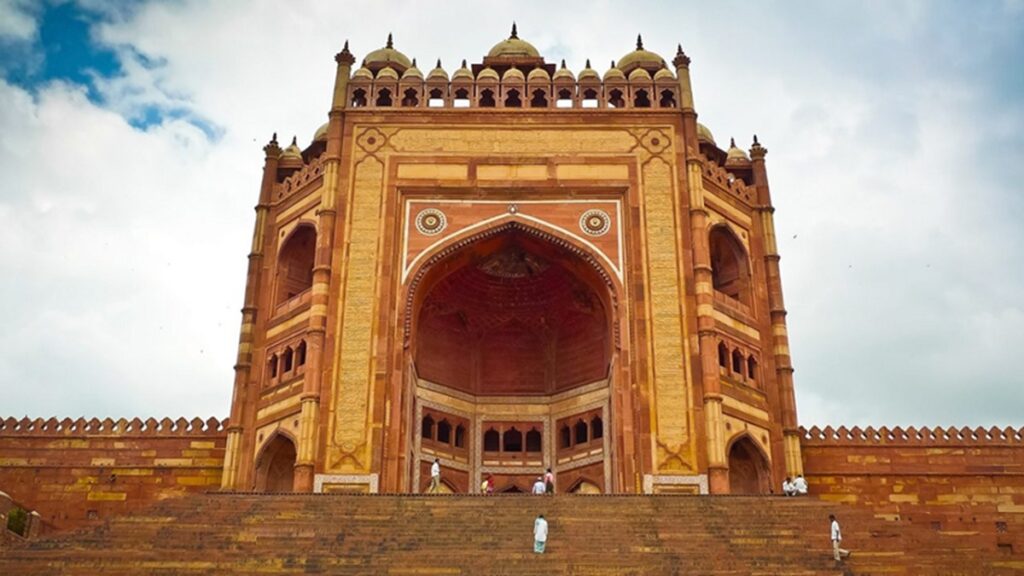
- What it is: The grand south gate to the Jama Masjid at Fatehpur Sikri, built by Emperor Akbar to mark his victory in Gujarat.
- How tall: About 40 m tall, but because it stands on a hill and high plinth it rises ~54 m from ground level; you reach it by 42 steps.
- Why it matters: It’s often called the world’s highest gateway and a textbook example of Mughal architecture in red sandstone with white/black marble inlay.
- Where: 43 km from Agra, Uttar Pradesh.
- Tickets & hours (palace complex): Open sunrise to sunset, closed Tuesday; ₹50 (cash) / ₹35 (online) Indians/SAARC/BIMSTEC; ₹600 (cash) / ₹550 (online) foreigners; under-15s free. (Buland Darwaza itself sits by the mosque courtyard.)
What exactly is Buland Darwaza?
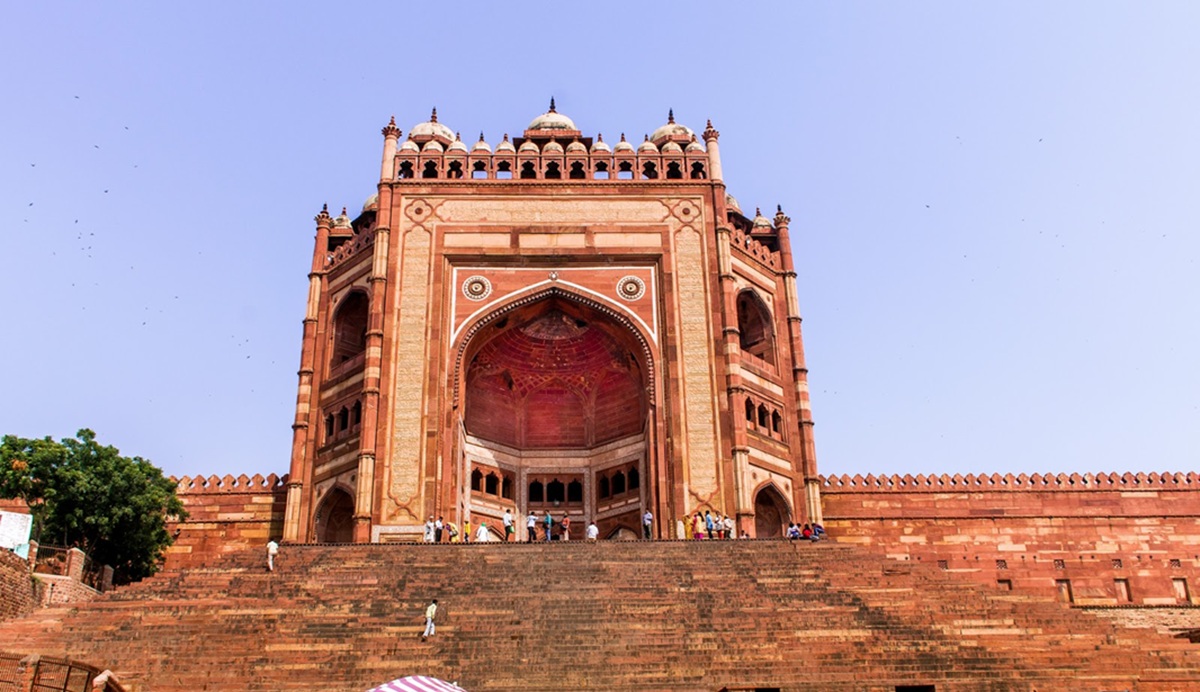
Buland Darwaza literally means “Exalted Gate” or “Door of Victory.” It’s the monumental entrance attached to the Jama Masjid at Fatehpur Sikri—Akbar’s short-lived capital near Agra. Think of it as a ceremonial triumphal arch that announces the mosque and the city beyond. Akbar ordered it after his successful campaign in Gujarat, turning a gateway into a message of power and unity.
Why Akbar built it (and what victory it marks)
In 1572–73, Akbar’s forces secured Gujarat, an event he wanted to memorialize in architecture, not just text. The Buland Darwaza was added a few years after the mosque’s completion as a victory gate. Most scholarly timelines place the gate’s completion around 1575–1577, shortly after the campaign. The UNESCO listing for Fatehpur Sikri specifically notes 1575 as the completion year and ties the gate to the 1572 Gujarat victory, which is why some sources quote both dates side by side.
How tall is it, really? (and why numbers differ)
You’ll see two measurements in guides, and both are right:
- About 40 m tall for the structure itself.
- About 54 m from the plain because the gate sits high on a terrace and hillside; the soaring steps amplify the height.
- 42 steps lead up to the main arch.
That’s why the gateway looks colossal in photos from below and is often described as the highest gateway in the world.
Materials & design you can spot in seconds
Stand at the base and look up: you’ll see red and buff sandstone with white and black marble inlay, a look that became emblematic of the early Mughal style. The façade is semi-octagonal, crowned with chhatris (domed kiosks) and lined with small turrets. From inside, the scale steps down humanely—classic Mughal design thinking: grand from afar, calm and usable up close. Best 11 Hill Stations to Visit This October Visiting Guide
The famous inscription that quotes Jesus (Isa)
Around the main arch is a Persian inscription recording a saying attributed to Isa (Jesus), son of Mary:
“The world is a bridge, pass over it, but build no houses upon it.
He who hopes for a day may hope for eternity;
the world endures but an hour; spend it in prayer, for the rest is unseen.”
Finding this on a Mughal monument surprises many visitors, but it fits Akbar’s broad religious outlook and the atmosphere of debate and dialogue at Fatehpur Sikri in his time.
What the inscription tells us about Akbar
Fatehpur Sikri wasn’t just a new capital—it was Akbar’s ideas lab. This is where he explored Sulh-i-Kul (universal peace), hosted interfaith conversations, and experimented with a composite culture. UNESCO’s description of the site highlights this environment and the city’s role in developing Mughal institutions and a fusion architectural style. The Jesus inscription underlines that spirit: wisdom could come from many traditions.
A quick architecture walk-through
- Grand stairs: The long flight of steps dramatizes the approach and adds visual height.
- Three arches: The central arch is the largest, flanked by smaller bays and crowned with layered openings.
- Chhatris above: Freestanding kiosks on the roofline create a rhythmic skyline.
- Pattern play: Look for white marble frames and floral inlays on red sandstone—subtle but refined.
- Inside effect: The interior scales down so the space feels welcoming, not overwhelming.
“Horseshoe Gate” — a luck-seeker’s tradition
Locals call the central opening the “Horseshoe Gate.” For centuries, people have nailed horseshoes to its giant doors for good luck—a folk custom you’ll still spot traces of. It’s a small, human detail on a very big monument.
Where it sits in the complex
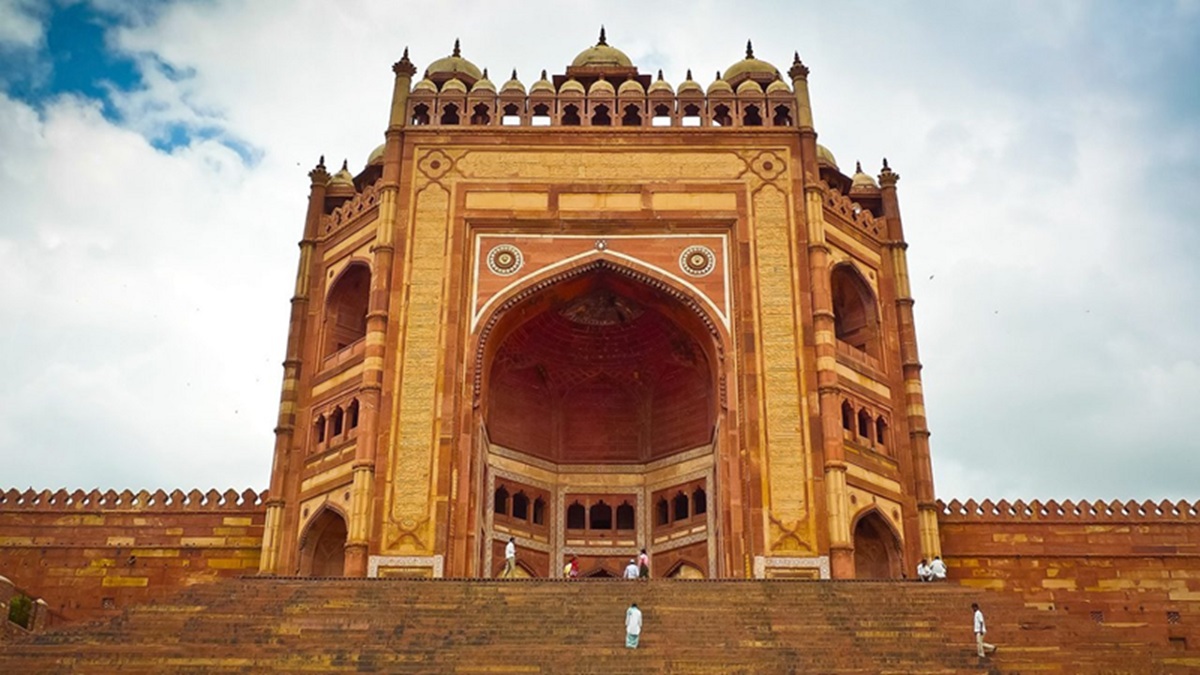
Buland Darwaza is set into the south wall of the Jama Masjid, forming the ceremonial entry from the ridge side. Because of this position, the gate not only frames the mosque courtyard but also acts as a city-facing billboard of Akbar’s message—power, piety, and welcome in one statement piece.
A gateway that scales space
Architects love Buland Darwaza for how it transitions from monumental to human scale. The outside is imposing; the interior bays, stairs, and balconies gently “shrink” space so worshippers and visitors feel comfortable once they pass through. This “macro outside, micro inside” trick keeps the gate grand and usable.
A fusion look before “fusion” was cool
The gateway shows Indo-Islamic fusion: Persian planning ideas, Indian trabeate elements, and local red sandstone. That blend isn’t accidental; it echoes Akbar’s political and cultural project—bringing peoples and styles together—which UNESCO identifies across the whole city.
The numbers that define the wow
- Height: ~40 m (structure), ~54 m from the plain.
- Steps: 42 up to the arch.
- Date: Added c. 1575–1577 after the 1572–73 Gujarat victory.
These figures are the reason the gate dominates every skyline photo of Fatehpur Sikri and still feels modern in its scale management.
Red stone, white frame
That striking red-and-white look—the red sandstone blocks edged and framed in white marble—became a signature Mughal aesthetic. It reads clearly from a distance and helps visitors pick out the arch lines and floral medallions even under harsh sun. Top Attractions to See in Golden Triangle India Route
The gate that’s also a message board
Beyond the Jesus quote, the eastern archway also carries an inscription recording Akbar’s conquests, including the Gujarat victory—so the gateway is both architecture and archive, telling you why it exists right on its own skin.
The “highest gateway” claim
Guides often call Buland Darwaza the highest gateway in the world. Whether you judge by architectural height or perceived height from the plain, the claim sticks because few portals combine mass + plinth + staircase so dramatically.
Exciting Agra Tour Itineraries:
- 2-Day Agra & Jaipur Sightseeing Tour
- 3-Day Delhi, Agra & Jaipur Golden Triangle Tour
- 4-Day Agra & Delhi Tour Itinerary
- Same-Day Agra & Mathura Road Trip
It’s the south-facing showstopper
Placed on the south of the mosque court, the gate catches warm light beautifully, especially in winter afternoons. Photographers love how the chhatris silhouette against the sky while the forecourt glows. (See the photography section below for quick tips.)
From fortress feel to spiritual welcome
Buland Darwaza looks like a fort wall at first glance, but it’s ceremonial, not military. Its job is to impress and invite, guiding you from the busy outer world to the calm of a mosque courtyard—a literal passage from noise to prayer.
A capital built on ideas
Fatehpur Sikri, where the gate stands, was Akbar’s planned city and a hub for new institutions like Ibadat Khana (house of worship) debates and a spirit of composite culture. The gateway is a front door to that whole experiment.
Not just big; it’s thoughtfully layered
Look closely at the three-tiered central arch and the pattern of cusped niches—they create depth and shade that keep the surface lively through the day, so you always see textures instead of a flat wall.
Why the steps feel “endless”
Because the base sits on a slope, the stair run is long and visually steep. That theatrical climb is part of the design—your perspective tilts up, making the arch feel taller than its already huge numbers.
A people place, not just a picture stop
The Jama Masjid courtyard behind the gate still hosts daily life and prayer. Respect the space: dress modestly, remove shoes where requested, and ask before photographing people. (More etiquette and tips below.)
Plan your visit — hours, tickets, closures
- Hours: Sunrise to sunset; closed Tuesday (palace complex).
- Tickets (palace complex): ₹50 cash / ₹35 online (Indians/SAARC/BIMSTEC); ₹600 cash / ₹550 online (foreigners); under-15s free.
- Museum: Archaeological Site Museum near Diwan-i-Am: 9:00–17:00, closed Friday.
Always check the ASI Agra Circle page before you go for the latest updates. (asi.nic.in)
How to reach Fatehpur Sikri (from Agra & Delhi)
- From Agra: ~43 km west; taxis or rideshares take 1–1.5 hours depending on traffic. UP State buses and CNG shuttle buses also connect to the site. Once you’re at the parking area, board the CNG shuttle to the monuments area (tickets are checked at the fort complex).
- From Delhi/Jaipur: Fatehpur Sikri sits on the well-traveled Golden Triangle. Trains stop at Fatehpur Sikri station; from there, take an auto or taxi. Best Time to Visit Golden Triangle India for Tourists
Best time to visit (and avoid the glare)
- Light & comfort: Go early morning or after 3 pm for softer light and cooler temperatures. Midday sun washes out the sandstone color and heats the steps.
- Season: October–March has the most comfortable weather in the Agra region.
Photography tips (simple and effective)
- Front step low-angle: Start at the bottom of the staircase and shoot upward to exaggerate height.
- Chhatri silhouette: Come late afternoon; isolate the domed kiosks against the sky.
- Detail frames: Zoom in on white marble inlay against red sandstone for patterns.
- Inside-out view: Step into the arch and frame the mosque courtyard beyond.
- Respect: Avoid flash near worshippers; ask before portraits.
Etiquette at a living heritage site
- Dress modestly (shoulders/knees covered).
- Shoes off where requested, especially near the mosque.
- No littering or scratching the stone; do not add nails or objects to the doors.
- Be mindful if prayers are in progress.
What else to see nearby (walkable highlights)
- Jama Masjid: The mosque that Buland Darwaza announces; look for the row of chhatris and triple mihrabs in each bay.
- Tomb of Salim Chishti: Pure white marble jewel box inside the mosque court.
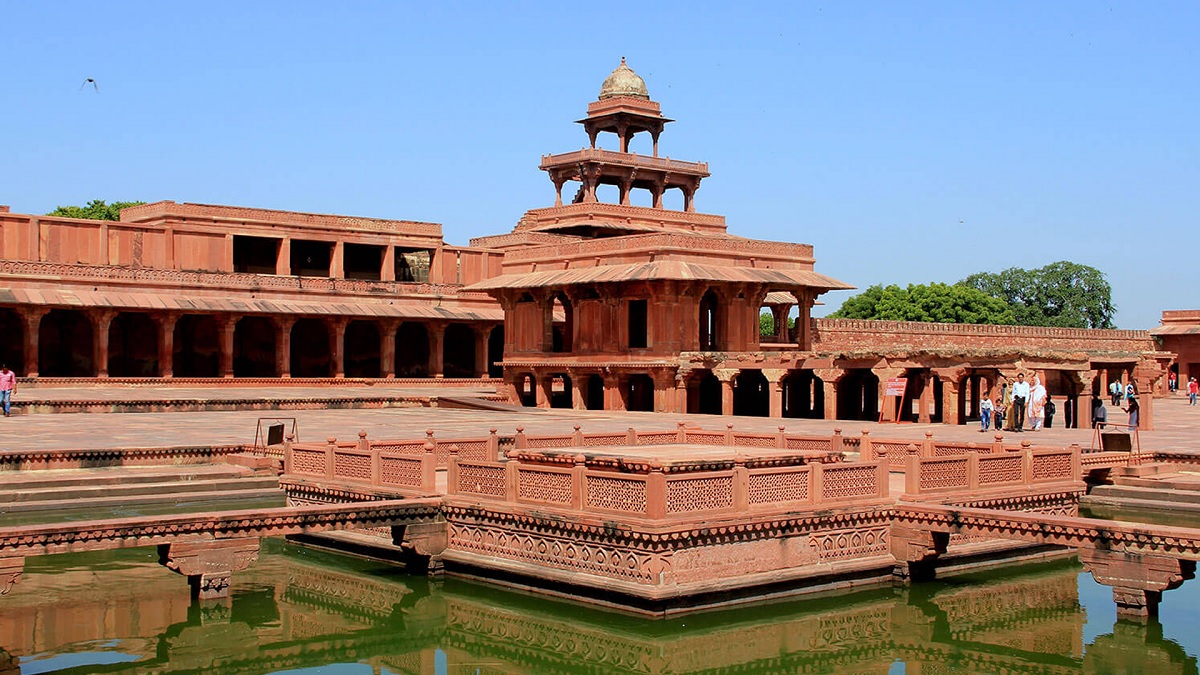
- Panch Mahal: A five-storey, airy pavilion—great for sunset photos.
- Diwan-i-Khas & Anup Talao: Hall of Private Audience and the iconic pool—classic Fatehpur Sikri photo stops.
Fun myth vs. fact (so you don’t get misled)
- “It was built in 1601/1602.” You’ll hear this in some guides and blogs. The UNESCO listing and most scholarship place completion around 1575 after the 1572 victory; Wikipedia notes it was added roughly five years after the mosque (finished 1571–72). The later dates likely reflect later mentions or confusion—the Gujarat victory is the key anchor.
- “It’s only a fort gate.” It looks like one, but it’s a ceremonial victory gate tied to a mosque, not a defensive barbican.
One simple route to experience it all
- Arrive via CNG shuttle; start at Buland Darwaza and take the iconic step photo.
- Enter the Jama Masjid courtyard; pause at the Salim Chishti tomb.
- Continue into the palace complex (ticketed): Diwan-i-Am → Diwan-i-Khas → Anup Talao → Panch Mahal.
- Finish at a sunset viewpoint near Panch Mahal, then return to the shuttle.
FAQs — Buland Darwaza, Fatehpur Sikri
1) Why is Buland Darwaza famous?
Because it’s one of the tallest ceremonial gateways anywhere, built by Akbar to celebrate his Gujarat victory, and it carries a unique inscription quoting Jesus—rare on Islamic monuments.
2) How many steps are there?
42 steps climb up to the main arch.
3) What is it made of?
Red and buff sandstone with white and black marble inlay; note the white frames around the red spandrels.
4) Is it part of the fort ticket?
Buland Darwaza sits by the mosque side. Most visitors also enter the palace/fort complex (ticketed) the same day—check ASI Agra Circle for prices and hours.
5) Best time for photos?
Early morning or late afternoon for soft light; winter skies are extra flattering.
6) Why does the height vary across sources?
Guides cite ~40 m (structural height) and ~54 m (height from the plain with plinth and slope). Both are correct in context.
7) Can I see the inscription?
Yes—look up at the main arch for the Persian text that includes the “world is a bridge” saying attributed to Jesus.
8) Is it really the highest gateway?
It’s widely described that way thanks to its combined structure + plinth + staircase height and dramatic setting.
9) Any dress code?
Modest clothing is respectful near the mosque; remove shoes if requested.
You Might Also Like:
- Agra Monuments Guide – Entry Fees & Visitor Info for Foreign Tourists
- Why Fatehpur Sikri Deserves Its UNESCO World Heritage Status
- Fatehpur Sikri Guide – History, Attractions, Fees & Best Visiting Time
- Best Historical Destinations in North India for a Family Trip
- Top Weekend Getaways Near Noida for Quick Scenic Trips
- India’s Heritage Gems – Complete Guide to 42 UNESCO Sites
- Best Taj Mahal Viewpoints for Stunning Photography
- Agra in February 2025 – Weather, Sights & Travel Tips
- One Day Agra Itinerary – Including Taj Mahal Visit
- Top 10 Places to Visit in Agra – Complete Travel Guide
- Taj Mahal Moonlight Visit – Dates, Tickets & Travel Guide
- Best Taj Mahal Views for Perfect Photo Shots
- Looking for More After the Taj? Discover Top Day Trips from Agra!
- Avoid the Crowds: Find the Best Season to Visit the Taj Mahal Now!